Travel guide
Best Luggage for a Jamaica Trip: Sizes That Fit a Transfer Vehicle
This guide may contain affiliate links. If you buy or book through one, we may earn a commission at no extra cost to you. Read our affiliate disclosure.
Choosing a luggage size for a Jamaica trip sounds simple until three questions land at once. The airline has its own limits, a week away does not need as much as you think, and somebody has to fit all of it into the car, van or minibus waiting outside arrivals. If you are travelling with family, or coming home with extra bags for relatives, that last question matters as much as the first. A suitcase can pass the airline's measuring frame and still leave your group sitting with bags on their laps. The good news is that a few measurements and one clear message to your transfer operator settle most of it. Start with the airline, because the airline decides what gets onto the plane at all.
Choose a Bag Size That Meets the Airline Rule and the Transfer Space
Your airline sets the first limit, and the ticketed carrier and fare decide what that limit is. Linear inches means length plus width plus height, measured on the outside of the case including wheels and handles. Several carriers publish the same standard figure for checked bags on many international tickets: Delta lists 62 linear inches and 50 lb, JetBlue lists the same, and American Airlines lists 158 cm, or 62 inches, and 23 kg, or 50 lb. Carry-on sizes differ. Delta and JetBlue list 22 x 14 x 9 inches, while Air Canada lists 21.5 x 15.5 x 9 inches.
These are examples, not a promise about your ticket. Fare type, route, aircraft and operating carrier can all change the answer, so check the baggage page for the airline that actually flies you before you buy anything.
The second limit is the space behind the driver's seat, and it is easier to plan for if you think in three sizes.
A medium case is usually the most useful compromise. It holds more than a cabin case, and it avoids the weight and volume risk of a large one. If you want to know where you stand on weight before you leave, a hand-held luggage scale is a small item that settles the question at home instead of at the check-in desk.
Pack for One Week Without Filling Every Available Inch
A medium checked suitcase, commonly about 24 to 26 inches tall, is a sensible starting point for one traveller taking a week of clothing, swimwear, toiletries and shoes. A light packer can manage with a carry-on by using laundry and compact clothing, and our guide to carry-on only travel to Jamaica covers how that works in practice.
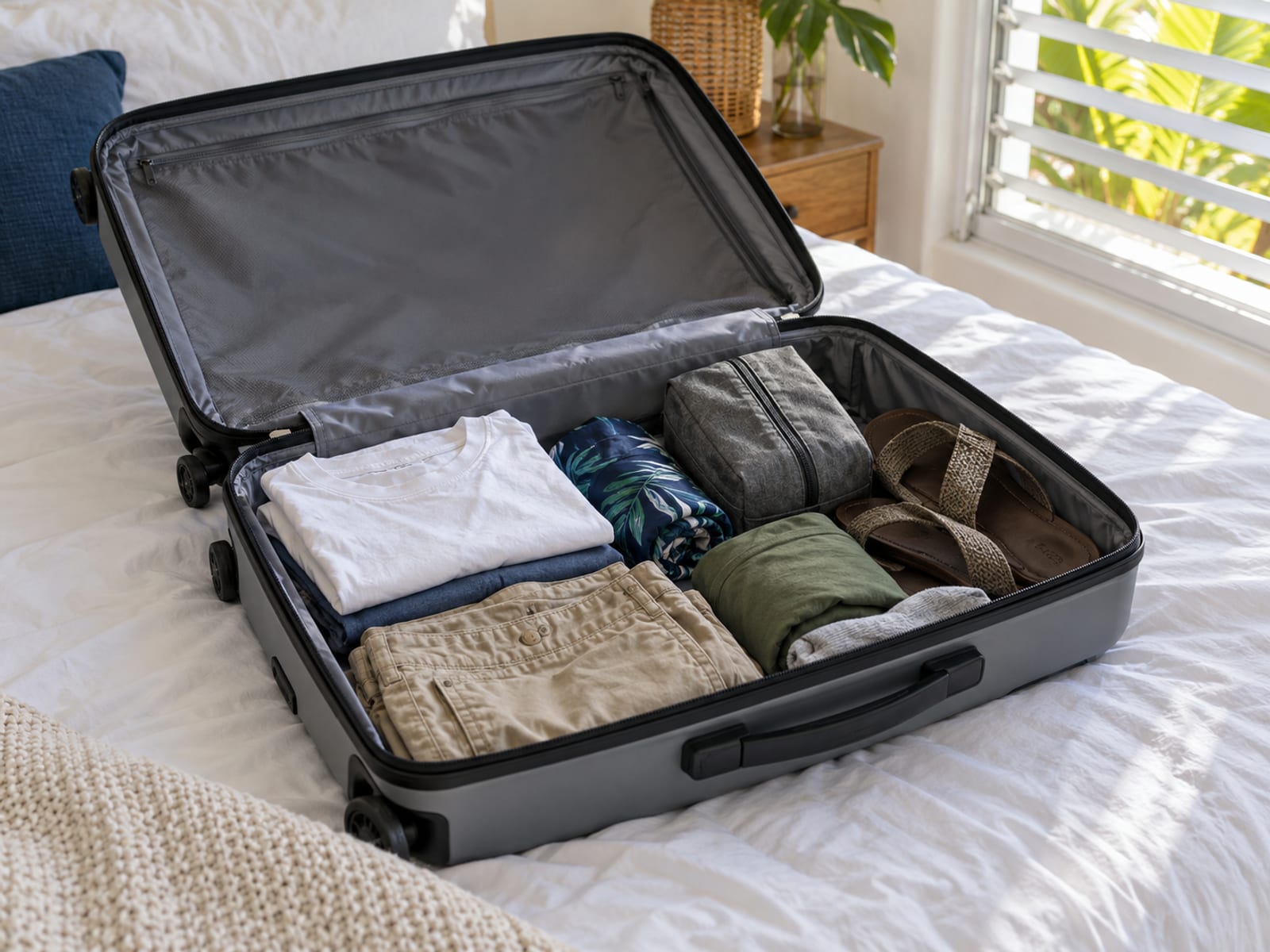
The case you choose matters less than what you put in it. Travellers who write about Jamaica trips often say they overpacked clothes and shoes. One traveller reported packing 21 swimsuits for a weeklong trip and wearing only a few favourites. That is one person's account, not a rule, but it is a useful warning. Clothing that mixes and matches takes less room than separate outfits, and packing cubes keep a medium case organised so you can find things without unpacking the whole bag.
If you like a simple formula, the 5-4-3-2-1 idea is one option: 5 pairs of socks and underwear, 4 tops, 3 bottoms, 2 pairs of shoes, and 1 dressy outfit, hat or swimsuit. It is a short-trip habit, not an airline requirement, and you can adjust it for beach days, a wedding or a cooler stay in the hills. For a fuller list built around seven days, see what to pack for a week in Jamaica.
Match Suitcase Construction to Kerbs, Steps and Rough Paths
How a suitcase is built changes how it behaves on the trip from the plane to your bed. The airport floor is smooth, but the last part of the transfer may not be.
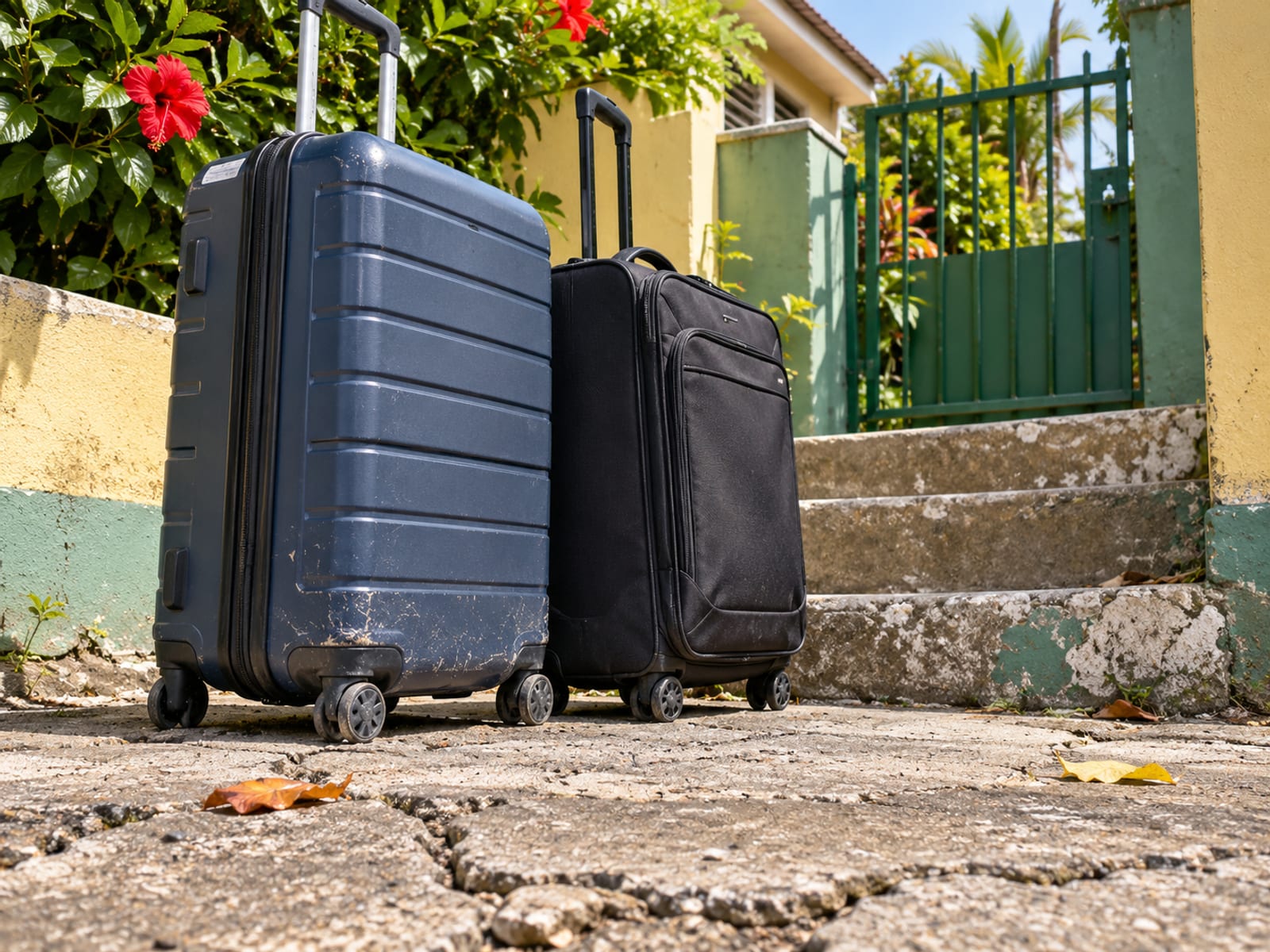
Hard-side luggage generally protects better against crushing, rain and knocks, but it has less give when it goes into a tightly packed vehicle. Soft-side luggage is lighter, has outside pockets, and can squeeze slightly into a car boot or van compartment, though it offers less protection from moisture and pressure. Rick Steves' packing advice and Travelpro's guide to wheel types cover the same trade-offs.
Wheels matter just as much. Four-wheel spinners glide across airport and hotel floors, but their small exposed wheels can be awkward on broken pavement, gravel, steps, kerbs and slopes. Two-wheel upright cases are pulled at an angle, keep the wheels more recessed, and are generally easier to manage across rough ground. A soft two-wheel case, duffel or backpack can help if your stay involves steps, uneven paths or a short carry from the vehicle.
So, think about the whole trip rather than one stretch of it. Hard-side protection suits fragile contents, soft-side flexibility suits tight storage, spinner wheels suit smooth surfaces, and two larger wheels or carry straps suit rougher ground. If your first stop is a guesthouse up a slope, that decides more than the brand name on the case.
Count Bags Before You Count Seats
There is no single figure for how many bags fit in a minibus, because luggage space depends on the vehicle model, the seating layout and the number of passengers. What is left after the seats are filled is the real limit, not the seat count on its own.
Some operators publish their own examples, and they show how much the answer swings. Each of these is that operator's figure, not a rule for every vehicle:
- FindCab: its 8-seater is listed with about one large suitcase per passenger, and its 16-seater with 10 cases.
- Westway Ride: an 8-seater is described as holding 8 large suitcases plus 8 pieces of hand luggage, with larger vehicles for oversized cruise trunks or extra equipment.
- BusXoXo: an 18-passenger minibus is described as holding roughly one carry-on per passenger, sometimes one medium bag, and a full 15-passenger van may hold only one small bag or backpack per passenger.
A car boot may take two or three large cases, and the back of an MPV or van can take more. A full minibus can have enough seats and still run short of luggage space. So, if you are a group of eight with eight large suitcases, a family of five with strollers and extra bags, or a household bringing gifts home, the bag count deserves as much thought as the headcount. Our guide to how much luggage fits in an airport shuttle goes through the planning for families and groups.
D-JARPS Transport Solutions runs its own vehicles and arranges transport anywhere in Jamaica as each trip needs it, so the numbers you send us are used to choose the right vehicle for your group. The same goes for an airport shuttle booking: the more exact your bag count, the better the match.
Protect the Essentials From Check-In to Hotel Arrival
Once the bag size is settled, protect what is inside it. Put a durable name tag on the outside of each bag and a second identification card inside. Include your name, mobile number, email address and where you are staying. Photograph the bag and its contents before you check it, and keep the airline's bag-tag receipt until the trip is finished.
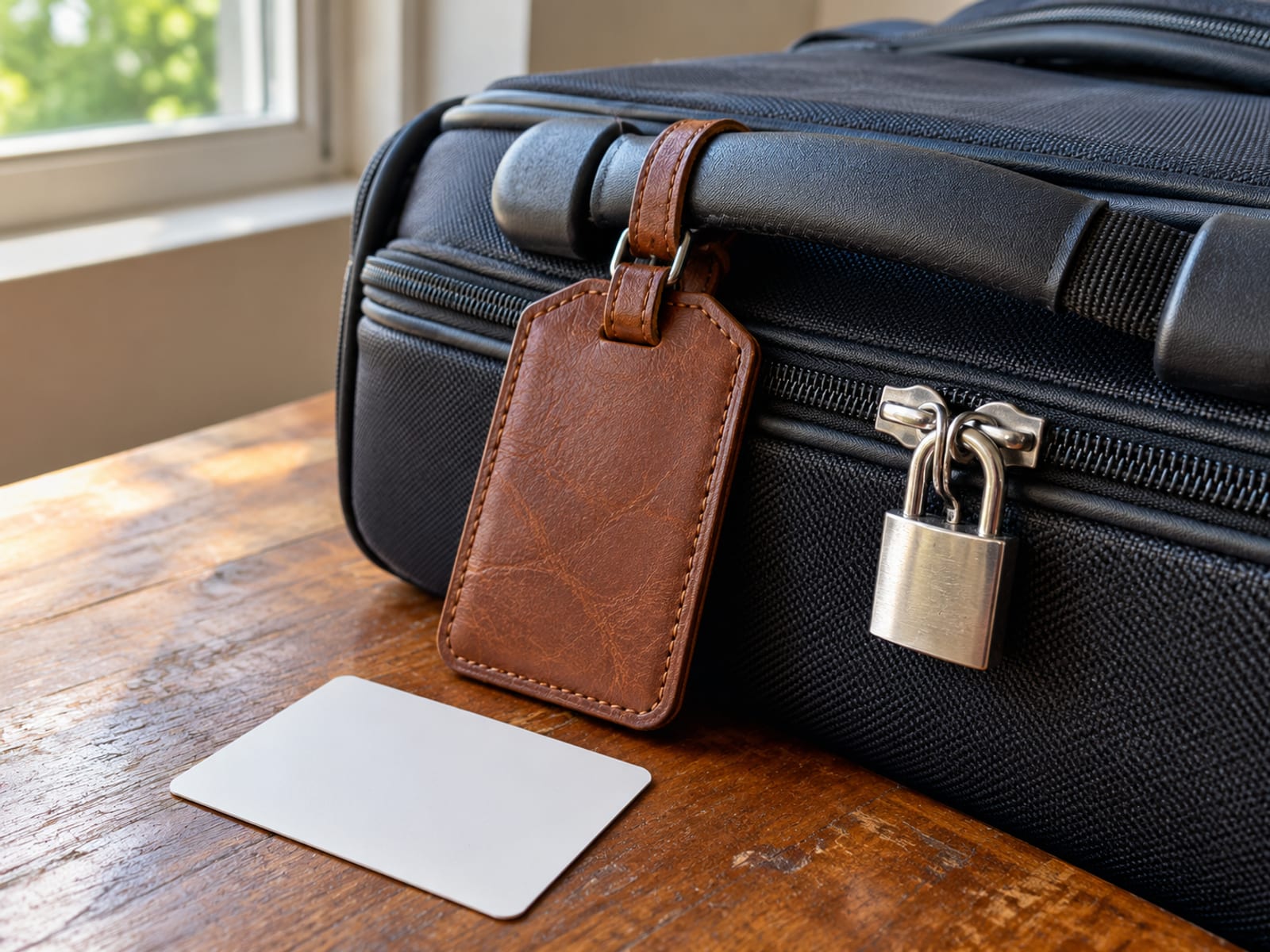
Use a lock the airline and airport security accept. JetBlue, for example, directs passengers to use TSA-approved locks. A lock does not prevent all loss or inspection, so keep passports, medicines, cash, electronics, jewellery and irreplaceable documents in your carry-on. Turn on baggage tracking in the airline's app if it offers one. IATA describes RFID bag tags as a way to identify and track bags at several points on their route. A personal Bluetooth tracker can add to that, subject to the airline's current battery rules, and a pack of Bluetooth trackers lets you put one in each main case rather than loose in a pocket of checked baggage.
One more habit helps. Traveller accounts often recommend carrying a few days of clothing, toiletries and medicines in the cabin bag in case a checked bag is delayed. One traveller described clothes missing from a child's checked bag and suggested keeping several days of essentials in the cabin bag. It is one person's story, and it costs almost nothing to follow.
Pack Jamaica-Specific Clothing, Health Items and Electronics
Many everyday things are easy to buy in Jamaica. The Jamaica Tourist Board points to local sauces, jams, spices, Blue Mountain coffee and Jamaica-branded clothing, and Rough Guides says Jamaican sauces and guava jelly are widely sold in supermarkets. Resort and airport shops may cost more than a local supermarket.
What is worth bringing is whatever is harder to replace on arrival: prescription medicines, preferred over-the-counter medicines, specialist toiletries, feminine hygiene products, specific baby products, specialist dietary foods and technical outdoor gear. The CDC advises travellers to bring the medicines they need, because medicines abroad can have different names or ingredients, and some products may be substandard or counterfeit. Bring a copy of your prescriptions and a medication list, and extra supply in case of delays.
Jamaica is warm all year, but temperatures change with elevation. A Meteorological Service of Jamaica outlook gave average temperatures of about 22.3 to 26.7 degrees Celsius for January through March 2023, with cooler conditions at Worthy Park. The hurricane season officially runs from June through November, and rain can arrive suddenly, so a compact travel umbrella or a light rain shell earns its place. The hills are cooler than the coast, so add a light layer if you plan a Blue Mountains day.
Health items travellers mention most often, and that CDC guidance supports, include:
- Sun protection: sunscreen, a hat, protective clothing and lip balm with sun protection. Mineral sunscreen is one option; the CDC page on sun exposure explains the basics.
- Insect protection: the CDC lists DEET, picaridin, oil of lemon eucalyptus or PMD, IR3535 and 2-undecanone as possible active ingredients, and an insect repellent with one of those ingredients is worth packing.
- Water footwear: travellers often wish they had brought water shoes for rocky beaches and rivers.
On electronics, the Jamaica Tourist Board states that the supply is 110 volts and 50 cycles, with two-pronged flat plugs similar to those used in the United States and Canada. Travellers from other systems should pack a suitable plug adapter and check whether any appliance needs a voltage converter. Plugs and voltage in Jamaica goes into more detail.
Clear Customs With the Right Items and Documents
Customs rules are easier to follow when you read them before you pack. The Jamaica Customs Agency states that passengers aged 18 and over may receive duty concessions on personal and household effects, including gifts, up to US$1,000 in total value, when the items are not for sale or commercial exchange. Its duty FAQ lists additional allowances of 170 ml of perfume, 340 ml of eau de toilette, 2 litres of alcoholic beverages, and tobacco limits of 200 cigarettes, 50 cigars or 230 grams of processed tobacco.
Some goods are restricted. The Customs Agency lists firearms and ammunition, toy guns, pepper spray, stun or Taser guns, bows and arrows, explosives, metal detectors, camouflage clothing and materials, and certain agricultural products. Camouflage is restricted because it can be mistaken for military or police clothing. Illicit drugs are prohibited, and the agency advises passengers not to carry packages for people they do not know unless they know what is inside.
If you are a Jamaican national returning permanently after living abroad for at least three consecutive years, different rules apply. Jamaica's Ministry of Foreign Affairs explains that eligible returning residents may import specified personal and household effects and tools of trade duty free, subject to the Returning Residents Unit's requirements. That is separate from the ordinary visitor allowance. PICA requires arriving travellers to present a valid travel document and complete the C5 immigration and customs form.
Confirm the Final Bag Count Before the Transfer
A few days before you fly, add up what you are actually bringing. Count the checked cases, the carry-ons, and every extra item such as a stroller, a box of gifts or a sports bag. Weigh each case and measure its outside dimensions, wheels and handles included. If you have a family trip or a group, write down who is carrying what.
Then check the ticket one more time. Air Canada, for example, states that travellers to and from Kingston are limited to one checked bag per person for travel dates between September 1 and January 15 each year. American Airlines' 2026 policy page lists Caribbean checked-bag charges of $50 for the first bag, or $45 online, and $60 for the second, or $55 online, for applicable tickets and routes. Fees and free-bag allowances can change with the fare, so rely on the booking-specific calculator on your airline's site.
Send the final numbers to whoever is driving you. If you are travelling with a small child, the baby and car seat planning guide lists the extra gear that families often forget.
Frequently Asked Questions
How much luggage fits in a minibus?
There is no universal figure, because space depends on the vehicle model, the seating layout and the number of passengers. Operator examples vary widely: one lists about one large suitcase per passenger in an 8-seater, another lists 8 large suitcases plus 8 hand-luggage pieces in an 8-seater, and another describes roughly one carry-on per passenger in an 18-passenger minibus. Give your operator the exact bag count before the vehicle is assigned.
What size suitcase for a week in Jamaica?
A medium checked suitcase of about 24 to 26 inches is a practical starting point for one traveller. A light packer can use a carry-on, and a large case is more likely to run over 62 linear inches or 50 lb.
What is the 5-4-3-2-1 rule for packing?
It is a short-trip formula: 5 pairs of socks and underwear, 4 tops, 3 bottoms, 2 pairs of shoes, and 1 dressy outfit, hat or swimsuit. It is a guide, not an airline requirement.
Which luggage size is best for Jamaica if I am bringing gifts home?
Count the extra bags when you plan the vehicle as well as the flight. Your ticketed airline controls the checked-bag limit, and customs allows up to US$1,000 of duty concessions on personal and household effects, including gifts, for passengers aged 18 and over when items are not for sale.
Should I choose a hard-side or soft-side suitcase?
Hard-side cases protect fragile contents better, while soft-side cases give a little when space is tight. Pick by what you carry and how rough the last stretch of the trip is.
Moving Forward
A good luggage plan comes down to four steps. Check the airline's limit for your ticket, choose a medium case of about 24 to 26 inches for a week, measure the outside including wheels and handles, and count your bags against the vehicle before anyone counts seats. Keep your documents, medicines and a few days of essentials in the carry-on.
Doing this a few days early saves the awkward moment at the kerb when the bags do not fit. It also makes it easier for everyone in your group to arrive with what they need.
At D-JARPS Transport Solutions, we run our own vehicles and arrange transport anywhere in Jamaica as each trip needs it. Trips are arranged by phone between 6 AM and 10 PM every day, or you can send a trip request through our contact page. Tell us how many people are travelling, how many bags you have and anything bulky, and we will go over the details, give you the price and confirm the trip before the day.