Travel guide
Plugs and Voltage in Jamaica: Do You Need an Adapter?
This guide may contain affiliate links. If you buy or book through one, we may earn a commission at no extra cost to you. Read our affiliate disclosure.
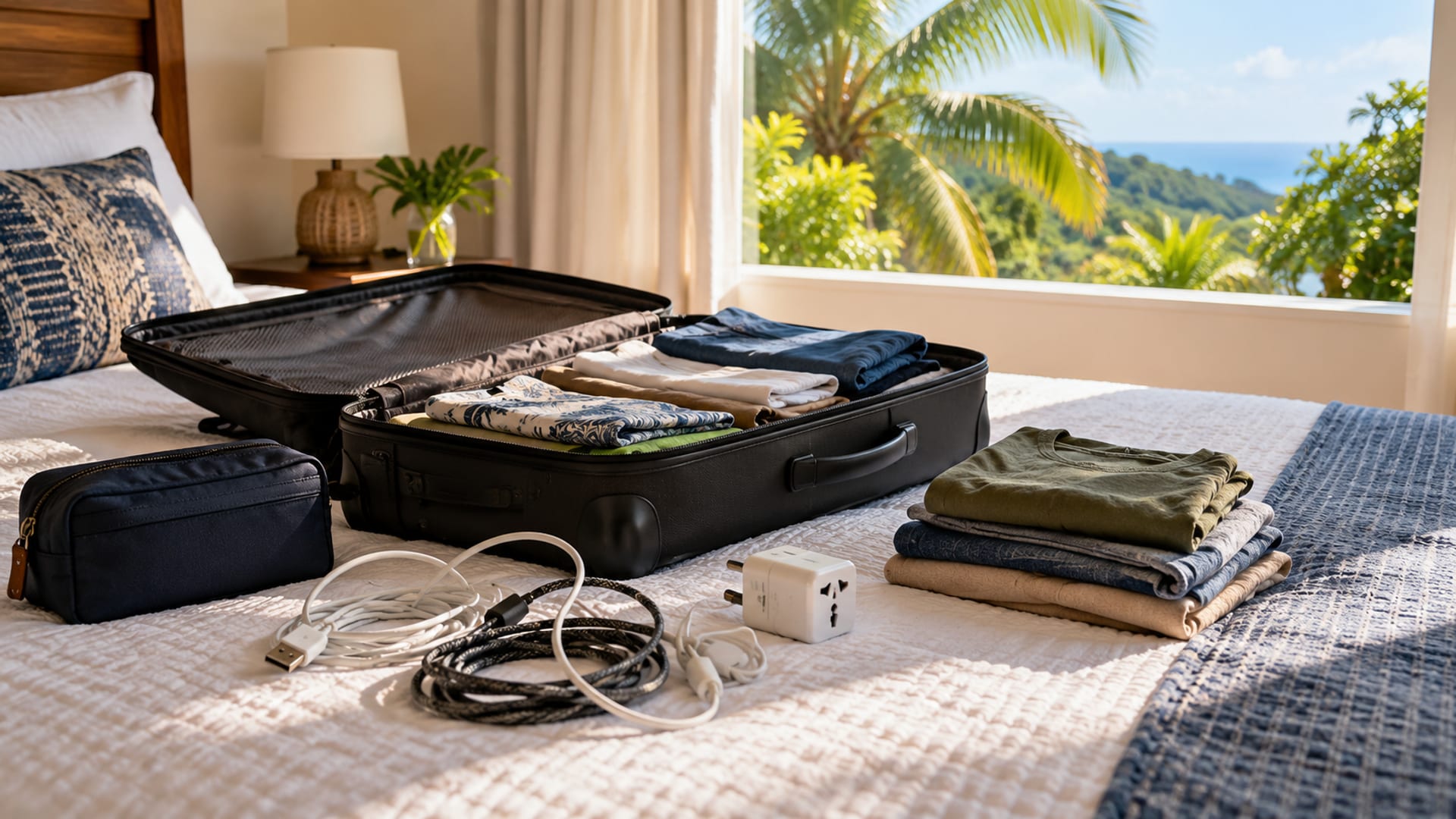
Standing over a half-packed suitcase with a pile of chargers, it is natural to ask: do I need a travel adapter for Jamaica? The question hides two separate ones that are easy to blur. First, will the plug physically fit the socket? Second, will the device accept the electricity that comes out of it? If you are coming from the United Kingdom, Europe, Australia or another region that runs on 220 to 240 volts, both answers matter. If you are coming from the United States or Canada, the plug shape will look familiar, but there is still one detail worth checking. Reading a label before you pack saves you from carrying things that will not work, and the steps below give you a clear answer for each device.
Do You Need a Travel Adapter for Jamaica?
It depends on where your plugs come from. Jamaica uses flat, North American style plugs, identified internationally as Type A and Type B. Type A has two flat parallel pins, and Type B has two flat parallel pins plus a round grounding pin. If your charger's plug does not match those shapes, you need a plug adapter, and a travel plug adapter is the simple answer for most phones, tablets and cameras.
For a visitor from the United States or Canada, the plugs fit. Many travellers from North America report using them directly. The one difference is frequency: Jamaica operates at 50 hertz, not the 60 hertz used in the United States and Canada. Most modern chargers handle that without trouble, but a clock or a motor-driven appliance is worth a label check.
For a visitor from the UK, Europe, Australia or New Zealand, the plug shape does not match, so an adapter is needed. The voltage is the second question, and the next sections cover it.
Jamaica Plug Types, Voltage and Frequency Are Easy to Check
The Jamaica Tourist Board describes Jamaica's electricity as 110 volts and 50 cycles, with flat two-pronged plugs similar to those used in the United States and Canada. You can read that on its general travel information page. So, is Jamaica 110 or 220 volts? For ordinary appliances it is 110 volts at 50 hertz, which is how the plug and the supply are described for visitors.
There is one caution. Some electrical installations in Jamaica provide 220 volt service for particular uses, so do not assume every outlet in every building is the same. Follow your accommodation's instructions, and read the label on the device you are about to plug in.
An adapter, a converter and a transformer do different jobs, and it helps to keep them apart:
- Plug adapter: Changes the physical shape of the plug so it fits the socket. It does not change voltage or frequency.
- Voltage converter or transformer: Changes the voltage. It must be rated for the wattage of the appliance, and small ones are not suitable for high-wattage hair tools.
- Dual-voltage device: Built to work across a range of voltages, and some hair tools have a switch that must be set to the right setting before use.
How to Tell Whether Your Charger Will Work
Every charger and appliance has a label with its electrical rating, usually on the plug body, the power brick or the back of the device. Look for a line that starts with "Input". It will list a voltage, a frequency and sometimes a wattage.
A label reading 100-240V, 50/60Hz normally means you need only a plug adapter if the plug shape differs. A device marked only 220-240V will not receive its designed voltage from Jamaica's 110 volt supply. It may run weakly, fail to heat or fail to work at all.
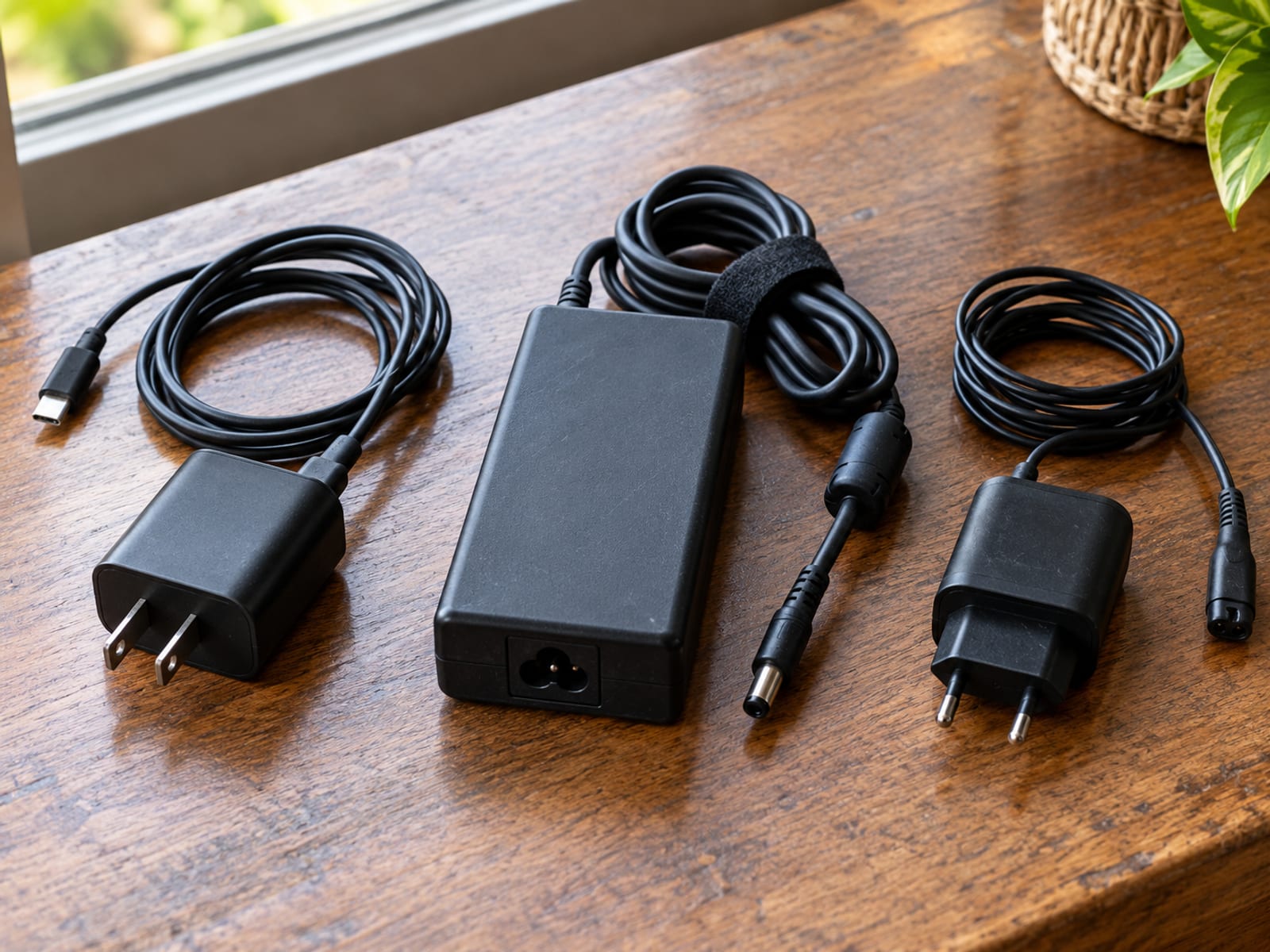
Devices commonly marked for 100 to 240 volts include phone chargers, tablet and laptop chargers, camera battery chargers, e-reader chargers, USB charging blocks, and many electric toothbrush and shaver chargers. For these, check that the range covers 110 volts and 50 hertz. If it does, a physical adapter is usually enough.
Phone Chargers, Hair Tools and Voltage Converters Need Different Answers
Phones, tablets, cameras and laptops almost always carry a wide input range, so they are simple. Hair dryers, curling irons, straighteners, heated styling brushes, travel kettles and some electric shavers are different. They produce heat or use a motor, and they are often built for a single voltage. An appliance marked only 220-240V may heat poorly or not at all on 110 volts. A converter or transformer for it must be rated for the appliance's wattage, and small converters are often unsuitable for high-wattage hair tools.
Many travellers decide that a bulky styling tool is not worth the trouble. Visit Jamaica says hotels often provide hair dryers, irons, radios and alarm clocks, but you should confirm with the property, because availability varies. Reports from travellers also mention limited room outlets, which makes a short extension lead or a multi-port USB charger handy, provided its label allows 110 volts.
Power Banks, Airline Rules and Charging During Transfers
A power bank is a spare lithium battery, and it travels in your cabin bag, not your checked bag. The Federal Aviation Administration states that lithium-ion batteries up to 100 watt-hours are generally allowed in carry-on baggage, that spare batteries and power banks are not allowed in checked baggage, that batteries from 101 to 160 watt-hours may need airline approval, and that anything above 160 watt-hours is generally prohibited on passenger aircraft. The FAA PackSafe page has the detail. If a carry-on bag is taken at the gate for the hold, remove the power bank and spare batteries first, and do not carry a damaged or recalled battery.
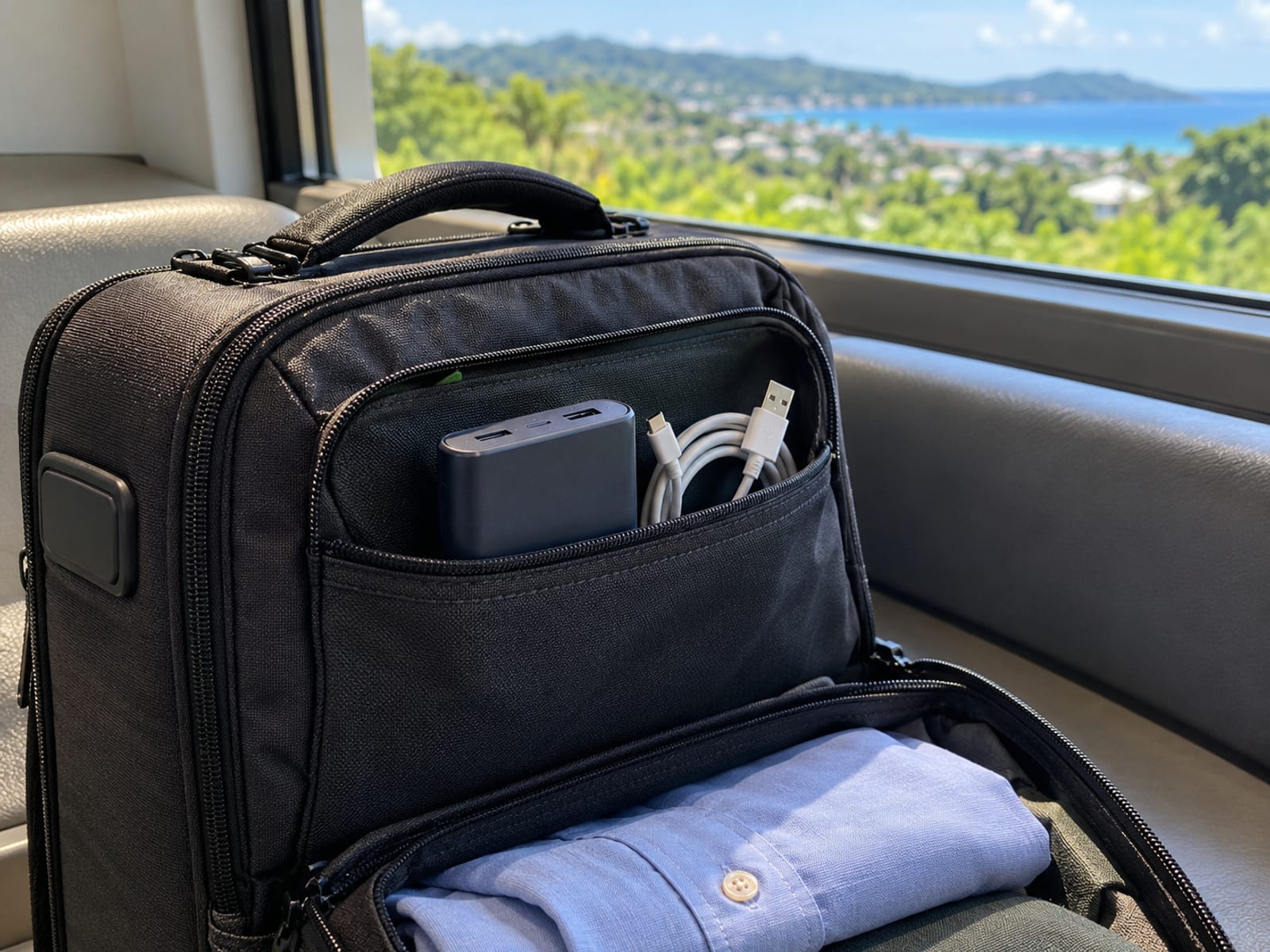
Airlines may be stricter. The IATA guidance on batteries says spare batteries and power banks must be carried in the cabin, and a 2026 IATA passenger document gives a limit of two power banks of up to 100 watt-hours each, kept out of overhead lockers. Check the operating airline's rules for your flight, and check the watt-hour rating printed on your power bank before you leave home.
On a long day of travel, a charged phone matters. It holds your boarding pass, your maps and your transfer details, so keep your cables and a power bank in the bag you carry with you. If you are arranging an airport pick-up, keep the contact details saved where you can read them even with a low battery.
Pack Electronics Around Weather and Power Interruptions
Travellers describe occasional power interruptions, particularly during storms, hurricane conditions, infrastructure work or travel outside major tourist areas. These are individual reports, not a national outage rate. Voltage concerns and limited room outlets also come up, and they differ by accommodation.
A few items cover most situations:
- A power bank within airline limits
- A charger with the right plug adapter
- Charging cables in your cabin bag
- A flashlight or the light on your phone
- A backup charging plan for a phone you rely on for maps, payments or contacting your driver
For essential electronics that will stay plugged in, a small, properly rated surge-protection device is an option. Unplug sensitive electronics during severe storms, and unplug anything if an outlet becomes hot, smells burnt, crackles or behaves oddly. A waterproof phone pouch protects a phone and cards at a beach or a river, which matters because the wet seasons are May to June and September to November, and the official hurricane season runs from 1 June to 30 November.
What Else to Pack for Jamaica's Climate and Health Needs
The adapter is only one line on the list. Jamaica is hot and humid year-round, and the Jamaica Tourist Board gives a broad range of 19 to 32 degrees Celsius. Higher ground is cooler, and sun exposure stays strong because sunlight reflects from sand and water. A light sweater or wrap helps in air-conditioning and on mountain visits.
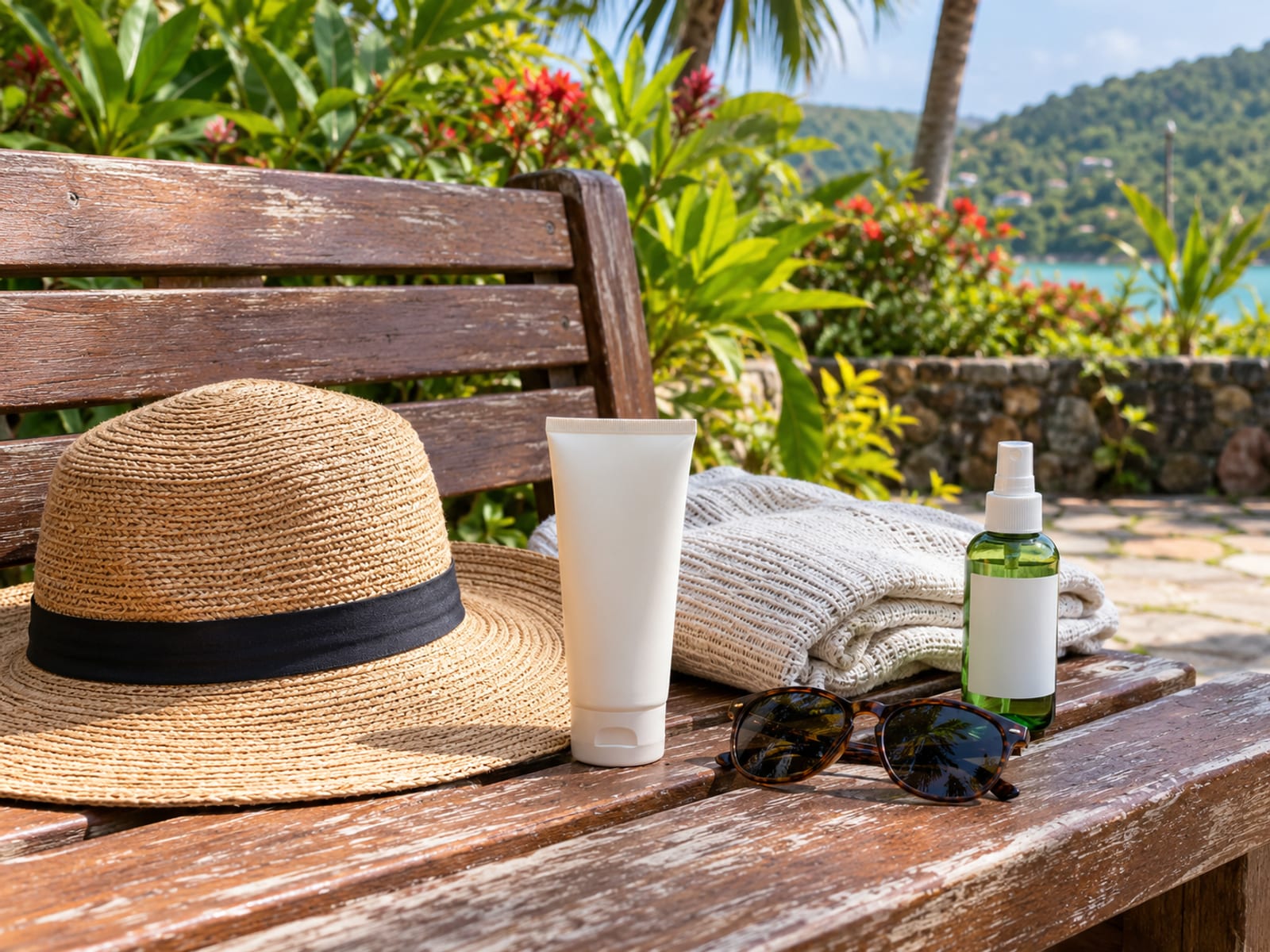
The CDC recommends sunscreen with an SPF of at least 15, protective clothing, a hat and shade during the strongest hours, and says to apply sunscreen first and insect repellent second. A mineral sunscreen is one option, and an insect repellent used as the label directs helps against mosquitoes. The CDC also advises bringing all prescription and over-the-counter medicines you may need, extra for delays, a basic first-aid or travel health kit, and a reusable water container. A small travel first-aid kit keeps basic supplies in one place. Visit Jamaica says treated drinking water is safe to drink, and the CDC Yellow Book says tap water in Jamaica is safe for drinking. If you have a medical concern, follow your doctor's advice.
Travellers also mention wishing they had packed water shoes for rocky beaches, comfortable walking shoes, a light rain jacket, a crossbody bag and a reusable water bottle, and many regret packing too much formalwear and too many swimsuits. Those are personal reports, not rules. For rain, a compact travel umbrella is small and easy to fit.
Our week-long packing list for Jamaica puts the clothing side together in one place.
Customs, Drones, Medicines and Luggage Planning Come Last
Before you finish packing, run through the rules for what comes in. The Jamaica Customs Agency says passengers aged 18 and over may receive duty concessions on personal and household effects, including gifts, up to US$1,000 when properly declared and not for sale. The Jamaica Customs duty FAQ also lists 170 millilitres of perfume, 340 millilitres of eau de toilette, 2 litres of alcoholic beverages and set tobacco amounts. Restricted goods that need a permit include meat and agricultural products, firearms, camouflage clothing, pharmaceuticals and chemicals. The list is not exhaustive and can change.
Drones are regulated by the Jamaica Civil Aviation Authority. Recreational use does not require a flight permit, while professional operations need a Special Aerial Work Permit. Keep prescription medicine in original packaging, and the CDC advises verifying that your prescriptions are legal in Jamaica. A traveller with a controlled or unusual medicine should confirm requirements with the Jamaican embassy or relevant authority before travel. Liquids, gels and aerosols in cabin bags are generally limited to containers of 100 millilitres or less in one transparent 1 litre bag, according to the Jamaica Civil Aviation Authority.
Airline allowances vary by fare, route and cabin. British Airways lists one economy checked bag up to 23 kilograms and a cabin bag up to 56 by 45 by 25 centimetres plus a smaller under-seat bag. American Airlines lists a standard checked bag of 23 kilograms and 158 centimetres in linear dimensions for most regions. A luggage scale keeps you under those limits. For the ride from the airport, published luggage figures differ between vehicle types and operators, and hard-shell cases, sports equipment and strollers use more space. Give your transfer provider the passenger count and exact bag count. Our guide to how much luggage fits in an airport shuttle shows what to settle before the day, and our airport shuttle service is arranged around those details.
Some of the words on charger labels and airline pages are easy to misread, so the main ones are defined here.
Frequently Asked Questions
Do I need a travel adapter for Jamaica?
If your plugs are the flat Type A or B shape used in the United States and Canada, usually not. If your plugs are UK, European, Australian or New Zealand style, yes, you need a plug adapter.
What plug does Jamaica use?
Flat, North American style plugs, known as Type A and Type B. Type A has two flat parallel pins, and Type B adds a round grounding pin.
Is Jamaica 110 or 220 volts?
For ordinary appliances it is 110 volts at 50 hertz. Some installations provide 220 volt service for particular uses, so check the label on your device and follow your accommodation's instructions.
Do I need a converter for Jamaica?
Only if a device is marked for 220-240V and cannot take 110 volts. Phone, tablet and laptop chargers marked 100-240V normally need only a plug adapter.
Can I bring a hair dryer or straightener?
Check the label first. Heat-producing tools marked only 220-240V need a converter rated for their wattage, and small converters may not cope. Hotels often provide hair dryers, but confirm with your accommodation.
Can I put a power bank in my checked bag?
No. Spare lithium batteries and power banks go in your cabin baggage, and your airline may set stricter limits than the usual 100 watt-hour guide.
The Bottom Line
Two checks answer the question. Compare your plug to Jamaica's flat Type A and Type B sockets, then read the input line on each charger and appliance. A label showing 100-240V, 50/60Hz normally needs only a plug adapter, while a device marked only 220-240V may need a converter, and heat-producing tools are the ones to check carefully or leave behind.
With that done, you can pack a short, sensible set of chargers, a power bank in your cabin bag and a few weather and health basics, and confirm what your room provides with your accommodation. Fewer devices also means fewer cables to lose between the airport and your door.
At D-JARPS Transport Solutions in Jamaica, we run our own vehicles and arrange transport anywhere in the island as each trip needs. Tell us your passenger count, your bags and your pick-up time, and we will go over the details, give you the price and confirm the trip before the day. Trips are arranged by phone from 6 AM to 10 PM every day, or through the trip request form on our contact page.