Travel guide
What to Pack for a Week in Jamaica
This guide may contain affiliate links. If you buy or book through one, we may earn a commission at no extra cost to you. Read our affiliate disclosure.
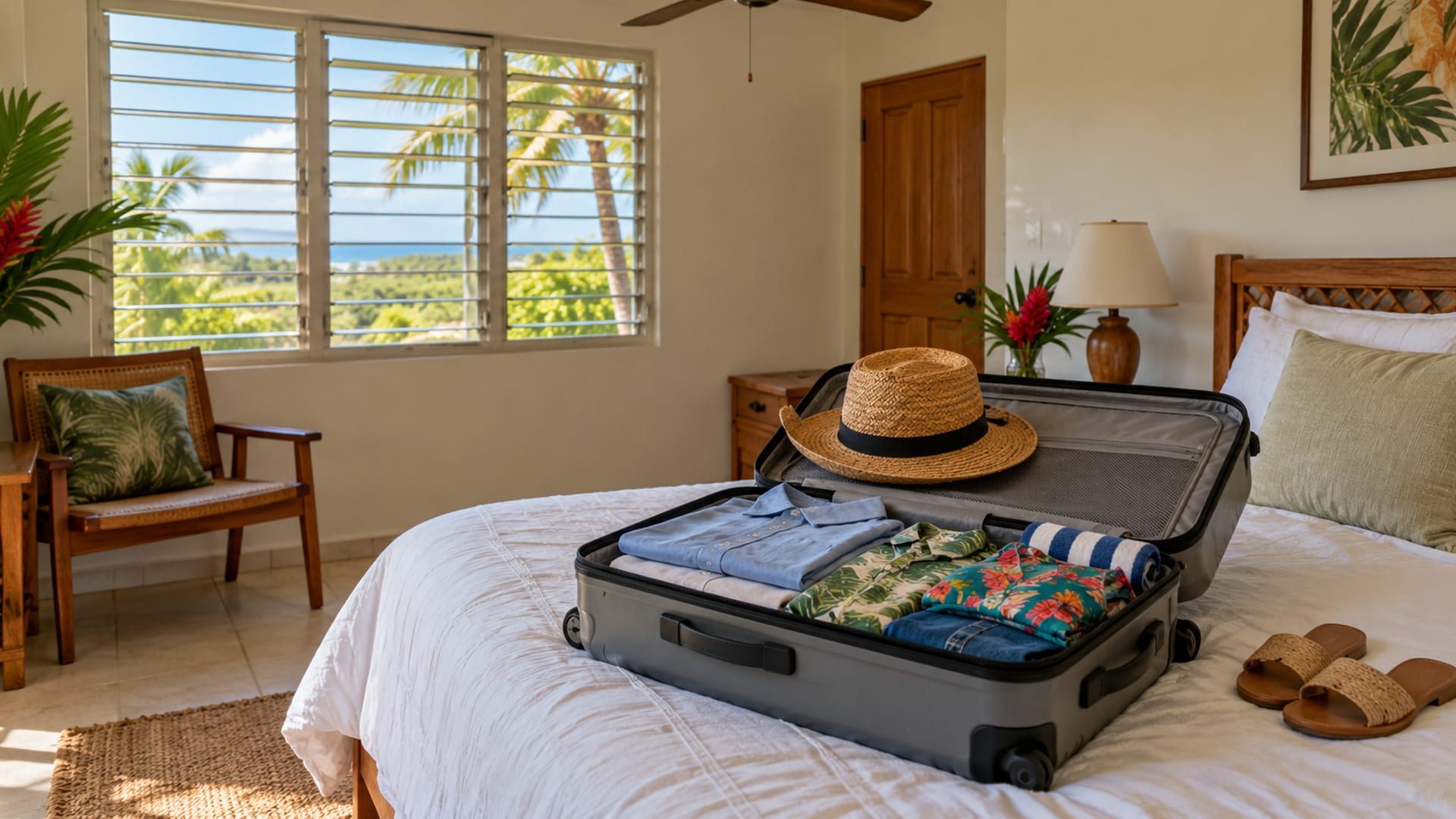
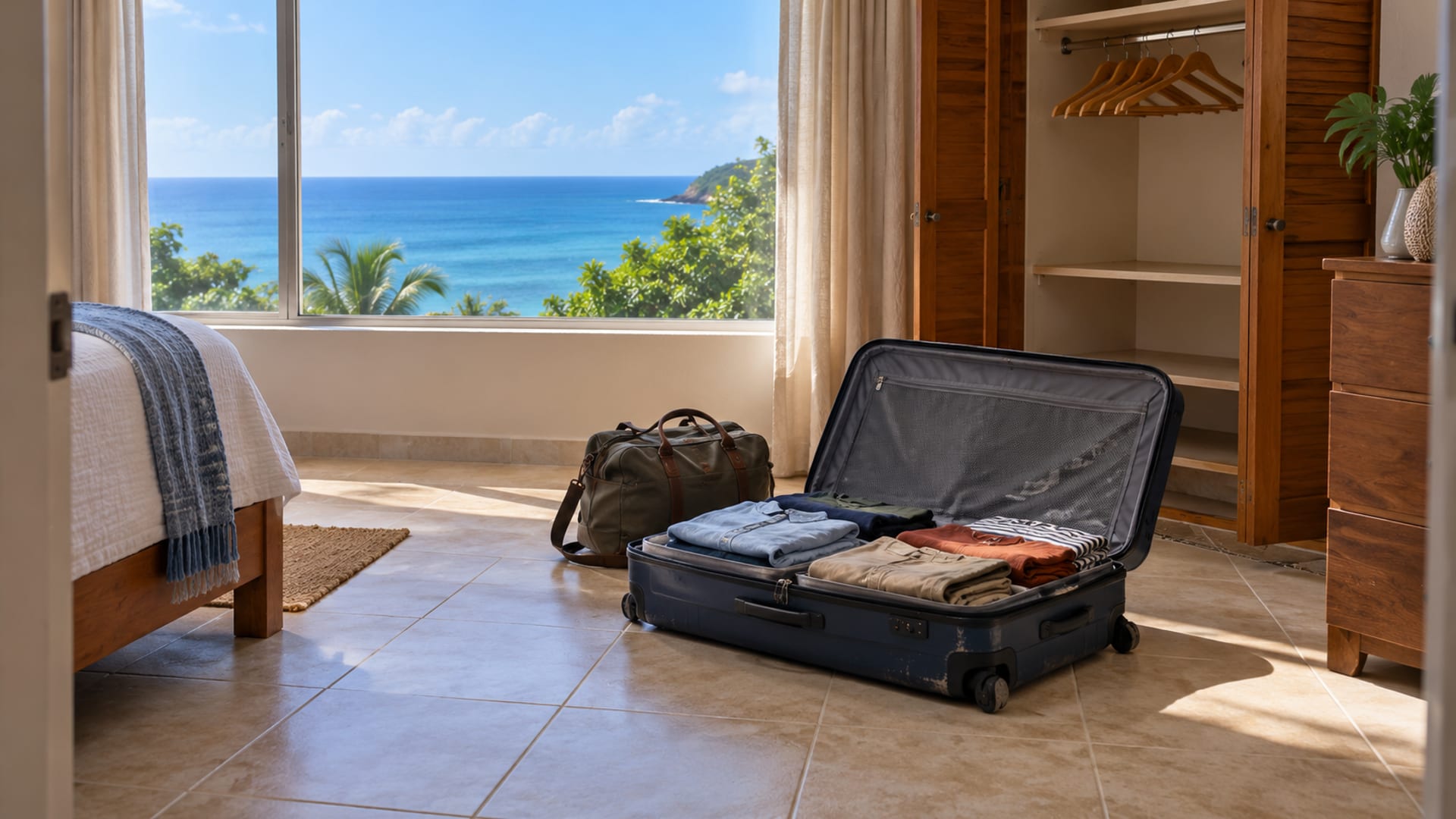
You have about seven days in Jamaica on the calendar, and the suitcase is still open on the bed. What to pack for a week in Jamaica comes down to a handful of choices you may not have made yet: resort, villa or Kingston; one bag or two; beach days or tours and hikes; and whether anyone will wash clothes. The heat makes the answer lighter than most people expect, but a few items are hard to replace once you land. Below is a base list you can pack from tonight, and then the ways it shifts for beach, town, mountain and evening plans. You will also see what Jamaica Customs restricts, what belongs in your carry-on, and how your bags have to fit the vehicle that meets you as well as the airline's rules. By the end you can write your own list and know what to confirm before you fly.
What Do You Actually Need for Seven Days in Jamaica?
Seven days does not require seven full outfits for the daytime. The Jamaica Tourist Board describes the climate as hot and humid, with temperatures from about 19°C to 32°C, so light, breathable clothes do most of the work. If laundry is available, a compact set covers the week: five to seven tops, three or four bottoms, two or three swimsuits, one or two cover-ups, one smart-casual dinner outfit, one long trouser or skirt option and one light layer. Add seven sets of underwear, three to five pairs of socks and two or three pairs of shoes.
You may have heard of the 5-4-3-2-1 rule: five tops, four bottoms, three pairs of shoes, two layers and one additional item. It is a flexible starting point, not a Jamaica rule. A beach week asks for more swimwear and fewer layers. A week of tours asks for sturdier shoes. Use the formula to get a rough shape, then change the numbers to fit your plans.
The list below is the full base list for a warm, mixed week. Print it or tick it on your phone as you pack.
What Clothing and Footwear Work in Jamaica's Heat and Humidity?
Choose fabrics that breathe and dry fast. Humidity slows drying, so a swimsuit that is wet from the morning may still be damp that evening. That is why two or three swimsuits serve you better than seven heavy outfits. Cover-ups are useful for the walk between your room, the pool and a restaurant.
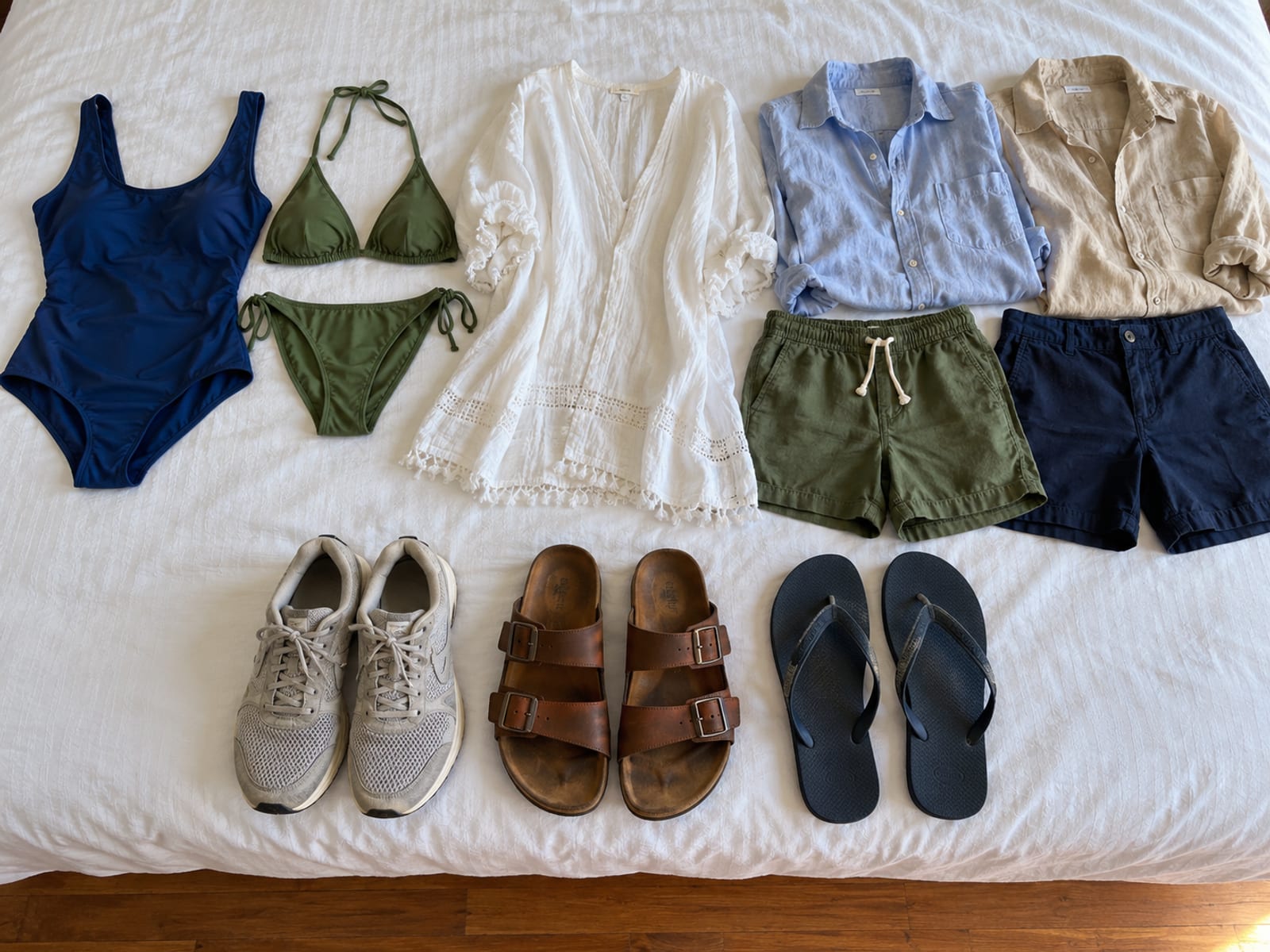
For shoes, three pairs usually cover a week: comfortable walking shoes for towns, tours and uneven ground, sandals or flip-flops for the beach and pool, and water shoes for rocky beaches, rivers and waterfalls. If you plan a nice dinner, one dressier closed-toe option is worth the space, because some restaurants ask for covered footwear. A good pair of water shoes for rocky beaches and rivers also doubles as a backup pair if your walking shoes get soaked.
Should you roll or fold? Use both. Roll soft, casual pieces such as T-shirts, underwear, swimwear and knitwear, because rolls fill awkward gaps. Fold structured or easily creased items such as linen shirts, jackets and trousers. If you want to keep rolled items sorted by day, packing cubes make the suitcase easier to open and close at each stop.
Can you wear orange in Jamaica? Yes. Orange is ordinary clothing. The item to leave at home is camouflage, which Jamaica restricts. In a sensitive election period, some people choose outfits that do not look like political colours, but that is a social choice, not a rule.
What Belongs in Your Carry-On From Departure to Arrival?
Think about what you could not replace if your checked bag arrived a day late. Those items ride with you. Jamaica's civil aviation guidance specifically lists valuables, laptops, cameras, phones, medicines, money, identification and credit cards as things to place in carry-on baggage.
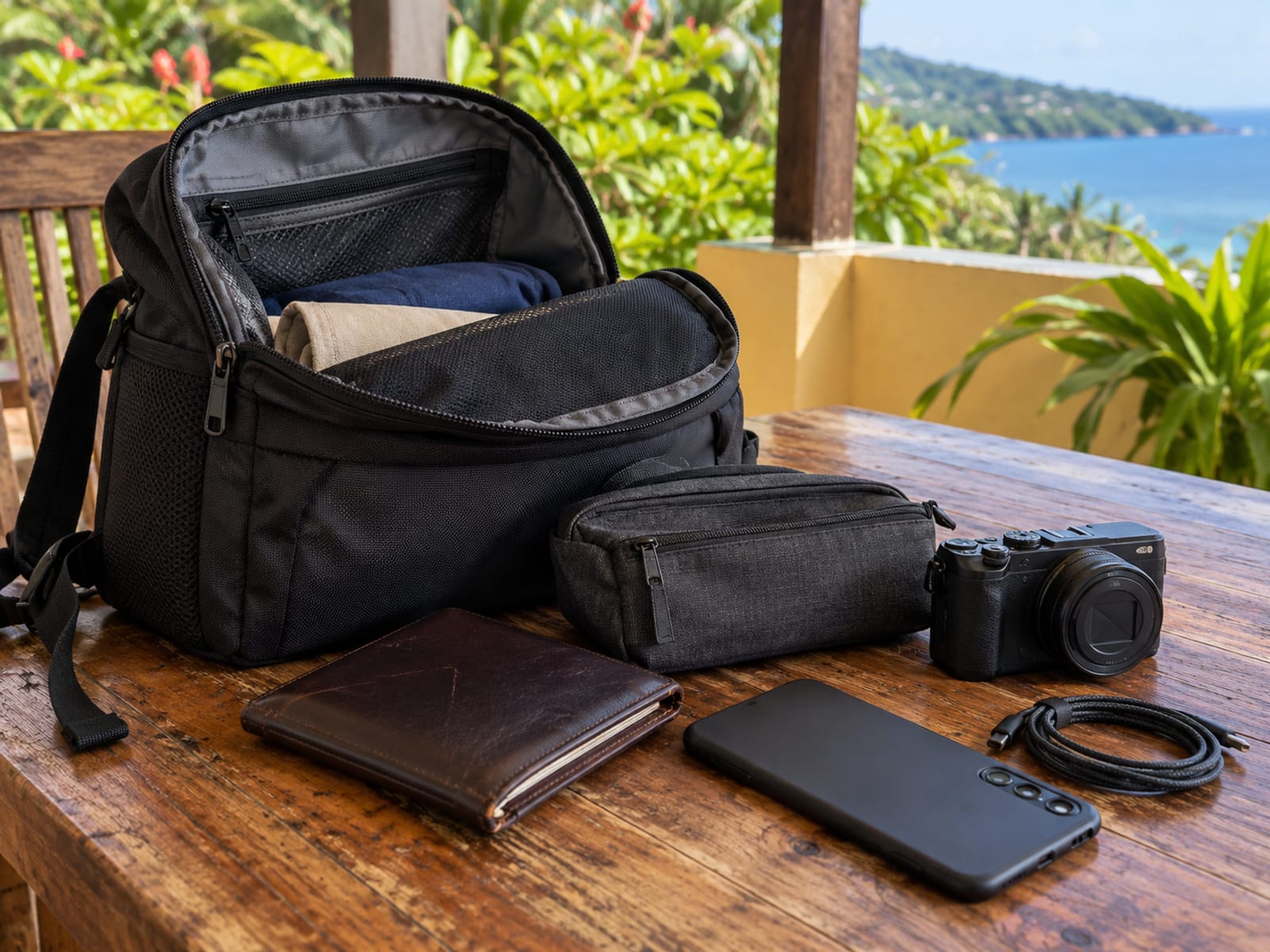
- Documents: Passport and entry documents, accommodation and transfer details, and travel insurance information.
- Money and valuables: Wallet, cards, a small amount of travel money, electronics and keys.
- Health items: Prescription medication, essential over-the-counter medicine, and prescription copies or a doctor's letter.
- Power: Phone, charger, and a power bank for long airport and excursion days.
- Basics: One change of clothes, underwear, basic toiletries, and glasses or contact lenses.
- Small items: An empty water bottle to fill after security, and small sunscreen within the airline's security limits for liquids.
Everything else can usually go in the checked bag: most clothing, extra shoes, full-size toiletries, large sunscreen containers, hair tools, beach gear and larger liquids. Dangerous goods are not allowed in checked or carry-on bags, and the airline's instructions apply on top of that.
What is the item most often forgotten? There is no single answer, but chargers, medication, toiletries, sunscreen, travel documents and underwear come up again and again. A last check of medication, charger, passport, sunscreen, insect repellent and swimsuit catches most of it.
How Does the List Change for a Resort, a Villa, Kingston or a Mixed Trip?
Your accommodation changes the list more than the calendar does. A resort suits several swimsuits, cover-ups, sandals, water shoes and one or two dinner outfits. Ask whether it provides beach towels, hair dryers, irons, toiletries and laundry, because the answer may let you leave things at home.
A villa asks for more self-sufficiency. Confirm laundry, kitchen supplies, towels, a hair dryer, screens and air conditioning before you go. A laundry bag and a small amount of detergent help if facilities are uncertain, and a remote villa deserves extra personal-care supplies. If you plan to bring groceries or food into Jamaica, read the import rules first, because food and agricultural restrictions apply.
A Kingston trip leans toward comfortable walking shoes, breathable city clothes, a light layer for air conditioning, and smart-casual clothing for restaurants, attractions and any business. Use a small secure day bag, not a beach tote, and pack less beach gear.
A mixed itinerary works best as a capsule wardrobe of tops and bottoms that match each other. Include swimwear, walking shoes, water shoes, one smart-casual outfit, one long trouser option and one light layer. If your stay stretches beyond a week, our guide to packing for a month in Jamaica explains the wash-and-repeat system.
What Should You Add for Sun, Rain, Mosquitoes and Mountain Weather?
Sun comes first. The CDC advises sunscreen with an SPF of at least 15, protective clothing, a hat, and shade during the hottest hours, roughly 10 a.m. to 4 p.m. Apply sunscreen before insect repellent. A mineral sunscreen is one option, and whatever you choose, pack enough for the week, since resort shops may charge more than you pay at home.
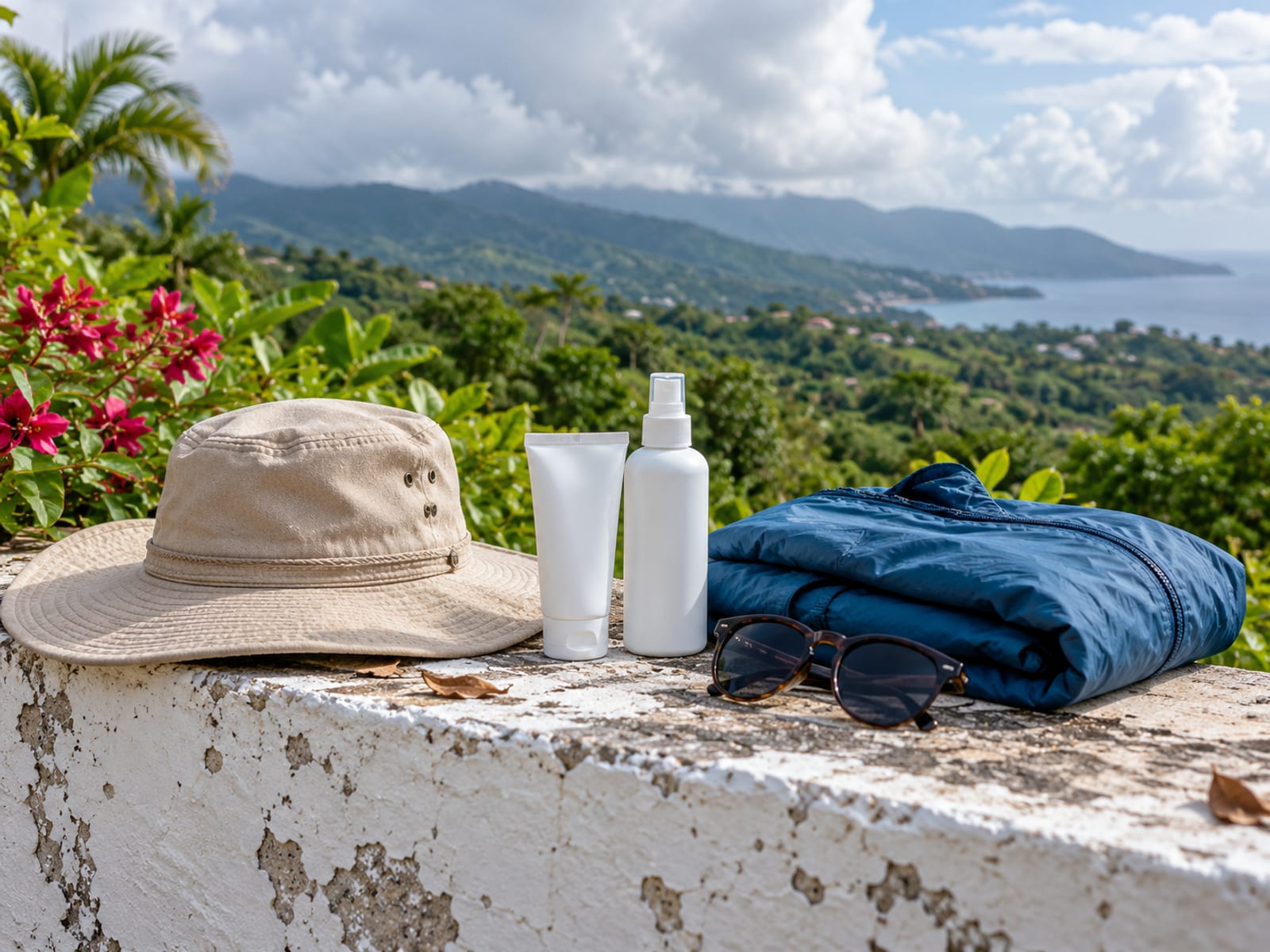
Mosquitoes call for insect repellent and, for evenings or hikes, lightweight long sleeves and long trousers. Itchy bites respond to hydrocortisone or calamine.
Rain shows up in two main seasons, May to June and September to November, according to the Jamaica Tourist Board. The official hurricane season runs from June to November. A compact rain jacket or poncho takes almost no room, and a waterproof phone pouch protects your phone, cards and documents at beaches, on boats and at waterfalls.
Mountain areas can feel cooler than the coast, especially at night. Cold fronts can also bring cooler nights from about mid-October to mid-April. A light sweater, long trousers and a rain layer cover it.
Can you drink the tap water? The Jamaica Tourist Board says drinking water is purified and filtered, and safe for drinking, brushing teeth, bathing and washing clothes. If you have specific health needs, follow your clinician's advice and choose sealed bottled or properly filtered water.
Finally, plugs. Jamaica uses Type A and Type B plugs and a supply of about 110 volts and 50 Hz. Visitors from the US and Canada can usually plug in directly, while travellers from other regions may need a plug adapter for Type A and B sockets. An adapter does not change voltage, so check the label on anything you plan to plug in.
What Does Jamaica Customs Restrict, and What Should You Leave at Home?
If you are wondering what you cannot bring into Jamaica, start with the items Jamaica Customs lists as prohibited or restricted. These include fresh fruits and vegetables, plants, meat, live animals, milk products, camouflage clothing and materials, firearms, ammunition, explosives, fireworks, toy guns, pepper spray, tasers, handcuffs and metal detectors. Honey is prohibited. Illicit drugs, including ganja, must not be imported or exported.
The electronic C5 declaration asks whether you are bringing food or animal and plant products, pharmaceuticals, chemicals, narcotics, weapons, cash over US$10,000, goods above the duty-free allowance, or goods for resale. Adults aged 18 and over have a US$1,000 allowance for personal and household effects, plus set quantities of perfume, alcohol and tobacco.
For the list that matters most to a typical visitor, the answer is short: leave camouflage at home, skip food, plants and honey unless you have checked the rules, carry medicines in original packaging, and answer the C5 form honestly.
How Do You Pack Around Airline Limits and Your Airport Transfer?
Airline rules vary by fare, route, aircraft and operating carrier, so use the allowance on your own booking. For reference, American Airlines lists a carry-on limit of 22 x 14 x 9 inches including handles and wheels, plus one personal item. Delta generally treats a standard checked bag as under 50 pounds (23 kg) and 62 linear inches. JetBlue lists a 22 x 14 x 9 inch carry-on, a 17 x 13 x 8 inch personal item, and a checked bag of 50 pounds and 62 linear inches. A luggage scale at home is cheaper than an overweight fee at the counter.
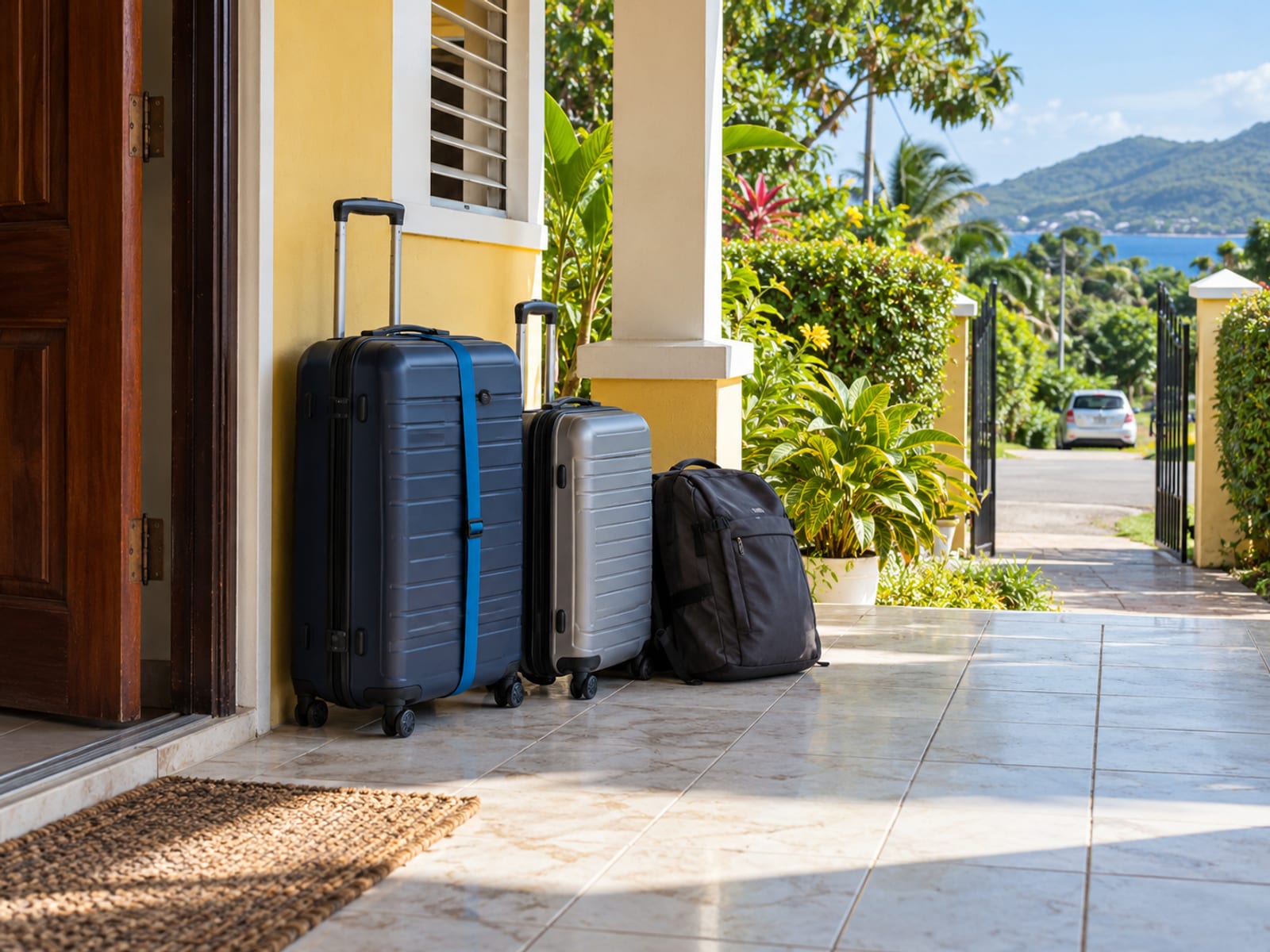
The second limit is the vehicle. Seats and suitcases are different counts, and a vehicle that seats nine people may not carry nine people with large bags. Operators publish their own figures, and they differ:
These are examples of how capacity is described, not a standard for Jamaican vehicles. The takeaway is to know your own numbers. Count passengers, suitcases, carry-ons and anything bulky, and give both counts when you arrange a ride. Our airport shuttle luggage guide shows how to do that step by step, and how to book an airport shuttle in Jamaica covers the details to send. D-JARPS Transport Solutions runs its own vehicles and arranges airport shuttle transfers to suit the size of your party and your bags.
Which Mistakes Should You Avoid, and What Are Travellers Glad They Packed?
The five mistakes that come up most are packing for every imagined situation instead of your real plans, taking too many shoes, filling the suitcase with no room for purchases, ignoring airline size and weight rules, and putting medication, documents, valuables or a change of clothes in checked luggage. Travellers also regret too many daytime outfits at all-inclusive resorts, bulky beach towels when the property supplies them, and assuming every beach has soft sand.
On the other side, people say they were glad to have extra swimsuits, water shoes, bug spray and anti-itch cream, a light shawl or sweater for air conditioning and ocean breezes, and a small dry bag or zip bags for phones, documents and wet swimwear. A reusable water bottle, a small first-aid kit, copies of passports and tickets, and a laundry bag also earn their space. These are individual accounts, not rules, but they match what the official health guidance suggests.
What is easy to buy after you arrive? Bottled water, basic snacks and toiletries, flip-flops, hats and sunglasses, and simple beachwear. What is harder? Specific prescription medicine, particular sunscreen formulas, familiar allergy or stomach remedies, chargers and adapters, and shoes in unusual sizes. Bring those from home.
A last tip on souvenirs: leave room. A half-empty suitcase on the way out becomes a full one on the way home, and the airline weight limit still applies.
Frequently Asked Questions
What can you not bring into Jamaica?
Jamaica Customs restricts or prohibits items such as fresh fruit and vegetables, plants, meat, live animals, milk products, honey, camouflage clothing and materials, firearms, ammunition, explosives, fireworks, toy guns, pepper spray, tasers, handcuffs, metal detectors and illicit drugs. Pharmaceuticals can need permits, so keep medicine in its original packaging with the prescription.
What is the 5-4-3-2-1 rule for packing?
It means five tops, four bottoms, three pairs of shoes, two layers and one extra item. For Jamaica, adjust it for swimwear, laundry access, excursions and dinner plans.
What is the most forgotten item when packing for vacation?
It varies, but chargers, medication, toiletries, sunscreen, travel documents and underwear are common. For Jamaica, check medication, charger, passport, sunscreen, insect repellent and a swimsuit before you zip the bag.
Is it better to roll or fold clothes in a suitcase?
Use both. Roll soft items such as T-shirts, swimwear and underwear, and fold structured items such as linen shirts, jackets and trousers.
Can I wear orange in Jamaica?
Yes. Orange is ordinary clothing. Leave camouflage and military-style prints at home.
Can you drink tap water in Jamaica?
The Jamaica Tourist Board says drinking water is purified and filtered. If you have specific health needs, follow your clinician's advice and use sealed bottled or properly filtered water.
Wrapping Up
A week in Jamaica needs less than you think: a handful of light tops and bottoms, swimwear, three pairs of shoes, sun and insect protection, and a carry-on that holds everything you cannot replace. Adjust the base list for your accommodation and plans, keep camouflage and restricted food at home, and confirm laundry before you cut the clothes.
Packing well also protects your first hours on the island. When your bags are counted and your documents are within reach, the ride from the airport is one less thing to sort out on the day.
D-JARPS Transport Solutions runs its own vehicles in Jamaica, and we arrange trips by phone, 6 AM to 10 PM daily, or through the trip request form. Tell us how many passengers and bags you are bringing, and we will go over the details, give you the price and confirm the trip before the day. Start on our contact page.