Travel guide
Sports Team Travel in Jamaica: Away Games and Match Days
This guide may contain affiliate links. If you buy or book through one, we may earn a commission at no extra cost to you. Read our affiliate disclosure.
The fixture is confirmed, the venue is across the island, and now it falls to you to get twenty-odd players, a coach, the kit bags and a bag of balls to the right gate at the right time, then home again after a match that might run late. Sports team transportation in Jamaica is mostly a planning job, and it is easier when you work backward from kickoff rather than forward from the drive. The kit has to fit, the arrival time cannot slip, and parents will want to know when the bus is due back. The sections below cover what to confirm before you ask for a quote, how to read vehicle sizes honestly and what a written quote has to say so that match day is not left to chance.
Plan the Away-Game Trip Around the Match, Not Just the Drive
School teams usually travel to away fixtures arranged through school competitions, while clubs travel through parish, regional, national or Jamaica Football Federation affiliated competitions. The Ministry of Education's guidance on school sport names ISSA-related participation and competitions such as Boys and Girls Champs and the Manning and daCosta Cup. Some football formats use home and away fixtures, which means your team will regularly play at somebody else's ground.
For transport, an away fixture normally means a private team vehicle, a school-arranged bus, parent-supported rides or a chartered minibus or coach. Public route transport is less suitable when the group must arrive together with kit and return after a fixed match time. Community reports describe student transport affected by limited availability, overcrowding and long waits, and vehicles that do not stop when already full. Those are individual accounts rather than a measurement, but they are a reason not to assume that a route bus will have space for a whole squad and its bags.
So, start the plan from the fixture. Confirm the venue and the exact drop-off point, the time players must be there for changing, briefing and warm-up, and whether the vehicle stays nearby during the match or returns later.
Choose the Vehicle by Players, Staff and Equipment
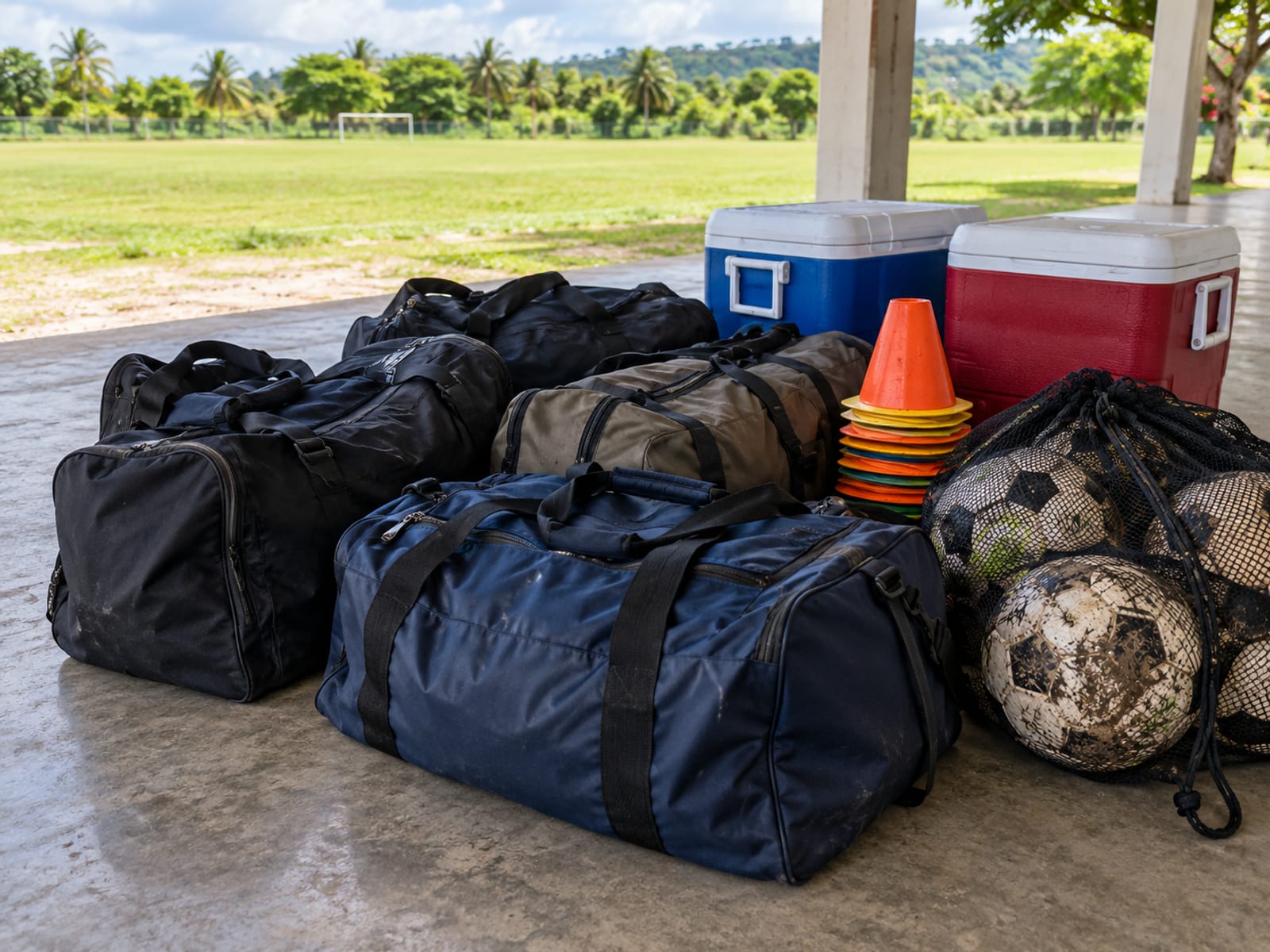
Count everyone, not only the squad. The headcount should include coaches, staff, substitutes and medical personnel. Then look at the kit: boots, balls, goals, coolers, medical bags, uniforms and personal luggage all need somewhere to go.
Capacity is where teams get caught. Published Jamaican operator examples show that "minibus" is not one fixed number, and that luggage can change it. The figures below are each operator's own, as published in October 2026.
That table answers how many seats are in a minibus: it varies by vehicle and by operator, so ask for the actual approved seating capacity and whether the quoted passenger count includes the driver. Then ask a second question, whether luggage reduces the number of usable seats. Under the Road Traffic Act 2018, the vehicle's approved seating capacity and classification control, not a general label such as "40-seat". If the nominal capacity leaves no room for equipment, a second vehicle may be the practical answer. For help choosing, what size bus your group needs goes through seat counts.
Build a Match-Day Timeline With Arrival and Return Buffers
Work backward from the required arrival time and write the day down. Visit Jamaica publishes indicative driving times between towns, including Kingston to Mandeville at 98 km and about 1.5 hours, Montego Bay to Negril at 83 km and less than 1.5 hours, Montego Bay to Ocho Rios at 100 km and less than 2 hours, and Port Antonio to Kingston at 109 km and less than 2 hours. These are tourism-board figures and not fixed match-day schedules. Actual time changes with city traffic, roadworks, crashes, weather, school dismissal periods, venue access, hills and winding roads, stops and the exact starting address.
Give the driver and the emergency contact numbers that will be answered all day, and tell parents the expected return process in advance.
Keep School Teams Covered by Permission and Supervision
When a school is involved, the transport is only part of the responsibility. The Ministry of Education's school sport guidance says schools should use licensed and insured vehicles, provide supervision, have trained professionals available for first aid and keep students supervised. It also says schools should talk to parents or guardians so consent is in place before participation and in case of a medical emergency, and that students should be medically cleared.
If your trip is a school outing more broadly, how schools plan field trip transportation covers the paperwork in more detail. Eligibility rules for ISSA-related events are set by the relevant bodies, so confirm those directly rather than relying on a transport provider.
Understand What a Jamaica Charter Quote Includes
Charter practice varies by operator, so treat each published figure as that operator's own. Published pages from October 2026 give a feel for the range without giving a team price.

- One operator lists a minibus at US$6 per kilometre for 13 persons, and a 26-seat vehicle at US$12 per kilometre, and presents these as service figures rather than a complete terms sheet.
- Another operator lists a driver-included charter for up to 15 passengers and describes its price as a starting price, subject to change with the charter's scope. It says the quote changes with pickup location, travel distance and specific requirements.
- A third operator lists driver and fuel-at-start terms in its description, and publishes a rate for a smaller passenger vehicle that is not a team-charter price.
What these show is that the price changes with vehicle capacity, luggage, distance and how the service is structured. Driver waiting, overnight driver charges, tolls, cancellation and deposits differ by operator, so get each one confirmed in writing by whichever operator you choose.
A quote request should therefore state the date, route, passenger count, equipment volume, number of stops, required arrival time, match duration, waiting requirement, late-return risk, fuel, tolls, parking and any overnight stay. The same list answers the common question of how much a 40-seater bus costs. There is no single published Jamaica figure to rely on, and foreign charter-bus price guides do not apply, so request a written quote for your actual route and date. For a fuller breakdown, what changes the cost of a bus charter in Jamaica explains each factor.
On tipping, one travel guide says 10% to 15% of the total fare is customary for a private driver in Jamaica, with US$1 to US$5 per passenger for an airport shuttle depending on trip length. Check whether a gratuity is already included in the quote, and decide in advance whether the organiser pays it or the passengers contribute.
Compare Operators by Capacity, Licensing and Written Terms
There is no universal best bus company for a private hire day trip. What you can do is compare the operators you are considering on the same points: vehicle condition, seating, luggage space, route familiarity, availability, cancellation terms and the total written quote. Visit Jamaica identifies private charter coach services as an option for large groups and school trips, and JUTC lists charter services, tours, special trips and event shuttles, and has announced an online portal for charters.

Licensing is the question worth asking every time. The Transport Authority licenses public passenger vehicles and commercial carriers. The Jamaica Information Service says a PPV-licensed vehicle can be identified by a red plate and a special windscreen sticker, that a contract carriage is hired at an agreed rate or sum, and that a contract carriage is not allowed to carry the general public. The Authority's requirement sheet lists a current registration certificate, certificate of fitness, insurance certificate or cover note and a PPV driver or conductor badge.
Ask each operator to confirm in writing:
- Pickup and venue: Exact pickup address, pickup time, venue address and return destination.
- Headcount: Players, coaches, staff, substitutes and medical personnel.
- Vehicle: Class, approved seating capacity, seatbelts, air conditioning and luggage space, and whether equipment goes in the cabin or a separate compartment.
- Itinerary: Stops, meal breaks, venue access and where the driver waits.
- Money: Fuel, tolls, parking and overnight expenses, deposit, payment schedule, balance due date, cancellation, refund and rescheduling terms.
- Contacts: Driver name or contact procedure, plus an emergency contact.
- Papers: Licensing, insurance, vehicle fitness and authority to carry passengers for hire.
Keep the essentials together in one place when you write to operators.
Prepare for Late Matches, Equipment and Unexpected Delays
Matches run late. A kickoff slips, extra time arrives, penalties follow, or a weather delay holds the teams on the field. A written return plan keeps a long evening from turning into an argument at the car park.
Ask these questions before the day:
- Who pays for extra waiting if the match runs late? Put a rate in the agreement.
- Where does the driver wait? Confirm a safe, legal place to park near the venue.
- Can the vehicle reach the actual entrance? Ask the venue.
- What if a player becomes ill or is injured? Decide who stays with the player and how the group continues.
- What is the backup if the driver is delayed? Get a second contact.
- What are the cancellation and postponement terms? Matches get postponed.
- How will you account for every player before departure, on arrival and before heading home? A simple roll call at each point works.
The Road Traffic Act 2018 also asks that vehicles carry the required safety equipment, including seatbelts, and that drivers cause passengers to wear seatbelts where required, and children use the prescribed restraint system where applicable. Ask the operator how driver hours, rest and late returns are handled.
Confirm the Local Road, Venue and Passenger-Safety Details
Before you finalise, check the last details that cost teams time. Try to learn the venue's entrance and where the team bus is allowed to stop, plus any rules on coaches, parking or alcohol and food. Confirm the actual venue address instead of a town name, because school and club grounds can be hard to find, and check how the route changes if heavy rain affects a road.
For safety, ask whether every passenger will have a seat with a seatbelt, how the equipment is secured so that nothing is loose in the cabin and whether the driver has a phone number you can reach during the match. Keep the numbers for the coach, the team manager and the driver on one sheet that every adult holds, and keep a written return time that the parents have seen.
Once the answers are on paper, the day itself is far less likely to depend on anyone's memory.
Frequently Asked Questions
What is the best bus company in Jamaica to hire for a private hire day trip?
There is no universal best operator. Compare licensed private charter providers on vehicle condition, driver credentials, seating, luggage space, route familiarity, availability, cancellation terms and the total written quote.
How many seats are in a minibus?
It varies. Published Jamaican operator examples range from about 8 passengers with luggage up to 15 for a minibus and up to 25 or 26 for a larger coach-style minibus. Ask for the approved seating capacity and whether the driver is counted.
How much is a 40 seater bus?
A Jamaica-specific 40-seat price should be quoted for your route and date. It changes with distance, hours, stops, waiting, luggage, fuel, tolls, overnight arrangements, vehicle type and availability, so request a written quote.
How much to tip a driver in Jamaica?
One travel guide says 10% to 15% of the total fare is customary for a private driver. Check whether a gratuity is already included, and decide in advance who pays it.
Does the driver wait during the match?
That is something to agree in writing, along with who pays if the match runs late and where the vehicle can wait.
What do school teams need besides a vehicle?
Parental consent, medical information, emergency contacts, supervision, an attendance register and a plan for collecting students after the return. Confirm them with the school.
Moving Forward
An away game goes well when the transport plan starts at the match and works outward: the arrival target, the kit, the headcount, the driver's waiting plan and the late return. With those written into a quote, the day is easier for coaches, parents and players.
Keep the checklist and reuse it for the next fixture, adjusting the route and the date.
If you are arranging travel for a school or club team, D-JARPS Transport Solutions runs its own vehicles in Jamaica and arranges transport anywhere on the island as each trip needs it. We go over your fixture details with you, give the price and confirm the trip before the day. Trips are arranged by phone from 6 AM to 10 PM every day or through the trip request form, so send us your date, venue, headcount, kit and return time through our contact page. Our private charter service explains how group trips are arranged.