Travel guide
Highway 2000 and Jamaica's Toll Roads: Costs and Paying
This guide may contain affiliate links. If you buy or book through one, we may earn a commission at no extra cost to you. Read our affiliate disclosure.
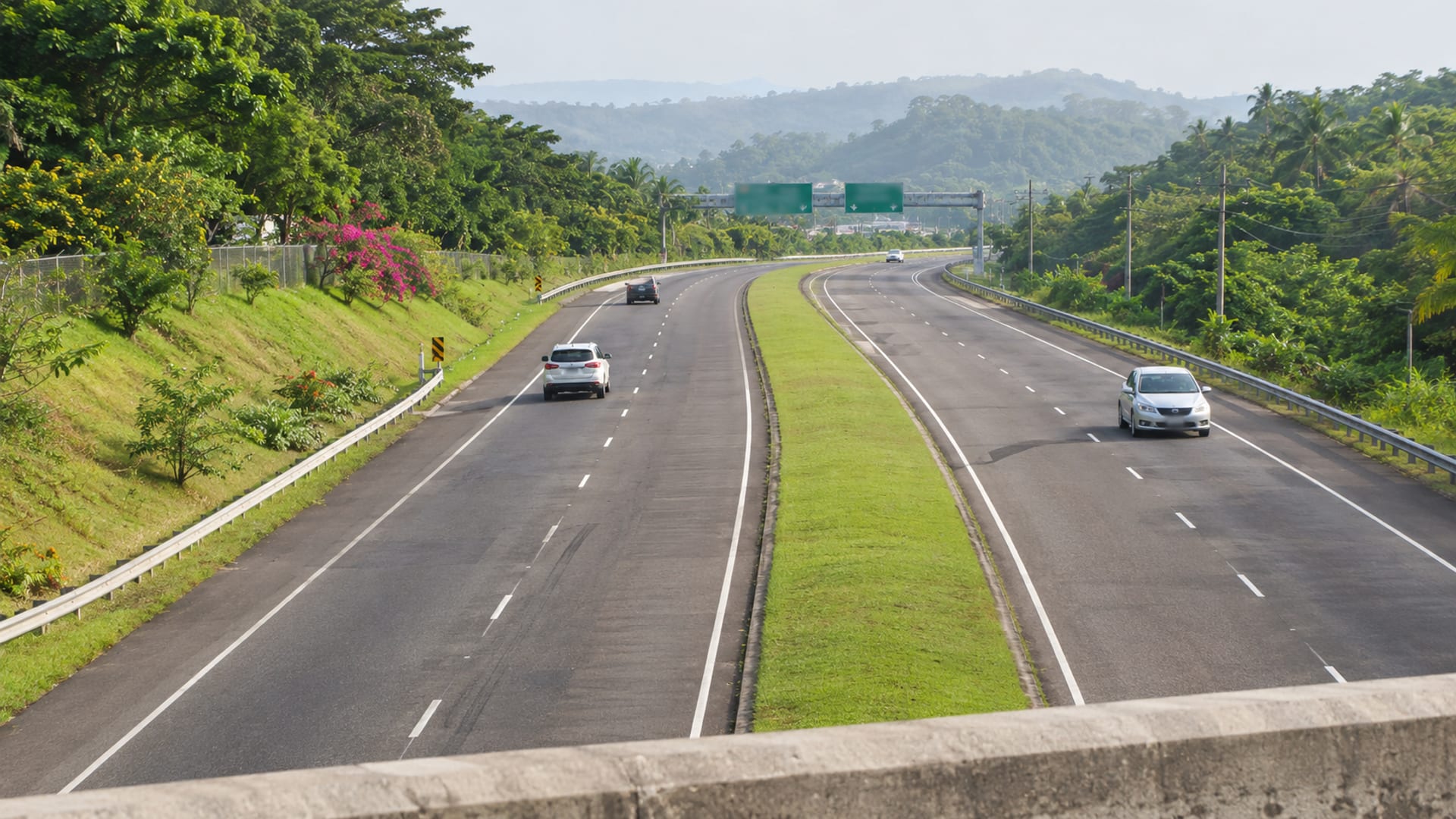
If your trip crosses Jamaica by car, you will probably meet a toll plaza, and the first question is usually how much it will cost and how to pay. The answer depends on which road you use, what size of vehicle you are in, and which company runs that stretch.
Jamaica has two tolled corridors, and each has its own operator, its own fare tables and its own payment rules. The published figures do not always match, so a single price would mislead you. What you can do is pin down your corridor, your vehicle class and the payment method before you leave.
The sections below cover who runs each road, what the operators currently list, how vehicle class changes the fare, and whether driving, taking a taxi or arranging a transfer suits your day.
Which Jamaica Toll Road Fits Your Route
The tolled network is often called Highway 2000, and it runs under two separate concessions. Your trip decides which one you use. Heading west from Kingston toward Portmore, Spanish Town, May Pen and Williamsfield puts you on the East-West corridor. Heading north from Caymanas toward Ocho Rios puts you on the North-South corridor.
The East-West corridor is run by TransJamaican Highway Limited, which trades as TransJam Highways. TransJam describes its T1 section as 71.9 kilometres between Kingston and Williamsfield, and its T2 section as 6.5 kilometres between Kingston and Portmore along the Portmore Causeway. Its main toll locations are Portmore, Spanish Town, Vineyards, May Pen, Toll Gate Ramp and Toll Gate Main Line.
The North-South corridor, also called the Edward Seaga Highway, is run by the Jamaica North South Highway Company Limited. It runs from Caymanas through Angels, Linstead, Unity Valley and Lydford to Mammee Bay near Ocho Rios. The Toll Authority regulates both concessions, and NROCC is the state-owned body that grants them. The Toll Authority lists the full Caymanas to Ocho Rios distance as 66.14 kilometres.
If your plans take you from Kingston to Ocho Rios, you will meet both: the city roads and the North-South corridor from Caymanas. If you are going to May Pen or Williamsfield, the East-West plazas are the ones that matter.
What You Pay at Each Toll Plaza
Toll fares are set per vehicle passage in Jamaican dollars, and every figure here carries a date because the tables change. Start with the East-West corridor. TransJam publishes its Class 1 cash figures on its toll rates page, effective 1 August 2026, and they range from J$270 at Toll Gate Ramp to J$850 at Vineyards.
The North-South fares come from two places, and they are not identical. The Toll Authority table dated 3 August 2026 lists Class 1 at J$2,500 for Caymanas to Ocho Rios. A table from NROCC, effective 28 August 2026, lists a Class 1 figure of J$1,900 for the same trip. NROCC also lists shorter sections: Caymanas to Angels at J$250 and Caymanas to Linstead at J$700 for Class 1.
Because the two North-South tables disagree, treat each figure as that source's own number for its own date. Use the operator's toll calculator or customer service to get the amount for the day you travel. The same applies to the East-West Class 3 figures, where the operator and NROCC tables show different numbers for some plazas.
Whether a fare is charged each way is a common question from visitors. The published tables list fares per passage, so ask the operator how your return trip is charged before you leave. The same goes for a taxi driver who has quoted you a toll: ask whether it is in the fare or paid on top.
How Vehicle Class Changes the Price
Both operators set the class by the height and length of the vehicle, not by how many people are inside. A saloon car and a minibus can pay very different amounts at the same plaza.
TransJam sets three classes. Class 1 is less than 1.70 metres high, of any length. Class 2 is 1.70 metres high or higher and less than 5.50 metres long. Class 3 is 1.70 metres high or higher and 5.50 metres long or longer. TransJam says sensors measure vehicle dimensions in manual lanes, and that roof racks, tyres and body modifications can change a vehicle's class.
JNSH uses four classes. Class 1 is below 1.70 metres high and below 5.50 metres long. Class 2 exceeds either 1.70 metres in height or 5.50 metres in length. Class 3 exceeds both. Class 4 covers motorised two- and three-wheel vehicles, according to the JNSH FAQ.
If you are renting a vehicle or hiring one, ask which class it falls into. A roof rack on a car, or a larger van for a group, can move you up a class and change the fare.
Cash, Cards, T-Tag, E-Pass, and What to Carry
On the East-West corridor, TransJam's FAQ says manual lanes take cash. Reporting from the Jamaica Gleaner in 2024 says debit and credit cards became available at the Portmore, Vineyards, Spanish Town and May Pen plazas. TransJam sales offices take cash, debit cards and credit cards, and Paymaster locations accept payments for T-Tag top-ups.
A T-Tag is a sticker linked to a prepaid account. Sensors read it and charge the account automatically. TransJam lists a T-Tag sticker and swipe-card package at J$2,500, which includes J$500 of opening credit, and says Class 1 and Class 2 T-Tag customers pay discounted rates. The My T-Tag app and online portal handle top-ups.
On the North-South corridor, the JNSH FAQ says the toll system accepts Jamaican dollars and US dollars in cash and that there is no credit system. If you arrive without enough money, nobody extends you credit, so carry enough cash or arrange an electronic account first. JNSH offers E-Pass, an electronic system, and says E-Pass users receive a 5 percent toll discount and can use an express lane. Payment options on both corridors have changed over time, so check the operator's site close to your travel date.
If you cannot pay, do not stop or reverse on the motorway. TransJam's T-Tag terms allow for a manual lane, a swipe card, another payment method, or a passage certificate if a tag fails or an automatic lane is unavailable.
How Much Time Highway 2000 Can Save
Published estimates point the same way, but all are dated and none is a promise for your day. The Jamaica Information Service reported that Kingston to Ocho Rios was expected to fall from about 1 hour 45 minutes on the regular route to approximately 45 minutes on the completed North-South bypass. A 2016 Travel Weekly report quoted tourism officials describing Kingston to Montego Bay as about two hours by Highway 2000, against more than six hours on the older route.
Visitors describe the real drive differently from the road-only figure. Visitor accounts on TripAdvisor put Kingston airport to Ocho Rios at about 1.5 to 2 hours, depending on traffic and the exact destination. Those are visitor reports, not official times.
The difference comes from everything around the toll road. You still need to get from the airport or New Kingston to the highway entrance, pass through Kingston and Spanish Town traffic, clear the plaza, and drive from the exit to your hotel or attraction. Weather, roadworks, the time of day and the day of the week all change the total.
Planning a Kingston to Ocho Rios Day
A day trip from Kingston to Ocho Rios works best when you plan backward from the one thing you cannot move. That might be a timed attraction, a ship's all-aboard time or a flight.
Official tourism material describes day trips as a base, one main attraction, transport, food and a return. Visitor accounts commonly describe leaving Kingston in the morning, using the toll road toward Ocho Rios, visiting one main attraction such as Dunn's River Falls, eating or shopping in Ocho Rios, and returning before evening traffic or darkness.
Dunn's River's own visitor guide estimates 1.5 to 3 hours on site depending on activities. Its online admission page says tickets must be bought at least 24 hours before the visit. Mystic Mountain lists Tuesday to Sunday, 8 AM to 5 PM, closed Mondays, with last general admission at 3 PM and last zipline admission at noon; confirm current hours with the operator for your date.
Allow time for parking, admission, queues and the return. If you start from the airport instead of central Kingston, allow more time, since the airport-to-highway connection is one of the harder parts of the drive. Check where you will park and whether you return by the same corridor, since that decides how many plazas you pay.
Driver, Taxi, Bus, or Rental Car
Each way of travelling handles the toll differently, so choose by what you want to manage yourself.
Self-drive gives you control over your departure time, stops and return route. It also means you handle the toll class, the payment method, left-side driving, parking and fuel. The Toll Authority says there are no filling stations on the highway, so refuel first. Visitors describe the toll highway as straightforward but find the airport-to-highway connection and local driving in Ocho Rios more demanding. If you are choosing between the options, our guide on whether to rent a car or book a driver goes through the trade-offs, and our post on fuelling a rental car covers the fuel side, which is separate from tolls.
A pre-arranged driver removes the need to find toll entrances and interchanges. Some visitors report that taxi or private drivers pay the toll on the passenger's behalf, but you should confirm in advance whether the toll is in the fare. If your trip begins or ends at the airport, an airport shuttle is one way to have the route and pickup agreed before you land.
The Jamaica Tourist Board describes route taxis as running fixed routes and chartered taxis as one-on-one arrangements with the fare confirmed at booking. JUTC runs scheduled buses, which suit routes where the timetable and return fit your plans but give less flexibility than a private driver.
Road Conditions, Safety, and Travel-Date Checks
On a tolled highway you plan your entry and exit in advance, since reversing and U-turns are prohibited, according to the Toll Authority. The East-West speed limit is listed as up to 110 kilometres per hour. JNSH lists 80 kilometres per hour, with 60 where applicable. Slow down in rain and fog, and keep left and pass on the right.
Pedestrians and cyclists are not allowed on the TransJam highway. If your vehicle has an emergency, move it fully onto the hard shoulder where possible. JNSH allows a breakdown on its motorway for no more than 30 minutes before its own wrecking service removes the vehicle, and does not permit unauthorised towing or roadside mechanics.
Check conditions for the day. JNSH posts advisories on its site, including temporary lane closures and service outages. Official travel advisories from the US State Department and Australia's Smartraveller warn about night driving, heavy rain, potholes and road closures, and recommend registered taxis, an agreed fare and seat belts.
A few terms come up again and again around the toll roads.
Frequently Asked Questions
How much is the Highway 2000 toll?
It depends on the corridor, plaza and vehicle class. TransJam's Class 1 cash fares, effective 1 August 2026, range from J$270 at Toll Gate Ramp to J$850 at Vineyards. For Caymanas to Ocho Rios, the Toll Authority lists J$2,500 for Class 1 and NROCC lists J$1,900, so confirm with the operator.
Can I pay Jamaica's tolls with a card?
TransJam's FAQ confirms card payments at its sales offices, and 2024 reporting says debit and credit cards are accepted at its plazas. JNSH says it takes Jamaican and US dollars in cash and has no credit system. Carry cash as a backup.
Is the toll charged each way?
Tolls are listed per vehicle passage, so ask the operator how your trip and return are charged before you travel.
Is it better to use the toll road or the old road?
Published estimates and visitor reports point to a faster trip on the toll road, but the time you save depends on traffic and where you start. Compare the fare against your schedule.
Do taxi drivers pay the toll for passengers?
Some visitors report that they do, but practice varies. Ask whether the toll is included in the fare when you agree it.
Final Thoughts
Your route decides your corridor, your vehicle decides your class, and the operator's current table decides what you pay. Carry enough cash, check for a T-Tag or E-Pass if you have one, and confirm the fare for your date before you set off.
Time spent on this before the trip means no surprises at the plaza and a clearer view of whether you want to drive, take a taxi or have a driver arranged for you.
If a pre-arranged driver suits your plans, D-JARPS Transport Solutions arranges transport anywhere in Jamaica as each trip needs it, using our own vehicles. We arrange trips by phone, 6 AM to 10 PM every day, or through the trip request form on our contact page, and we go over the details, give the price and confirm the trip before the day.